

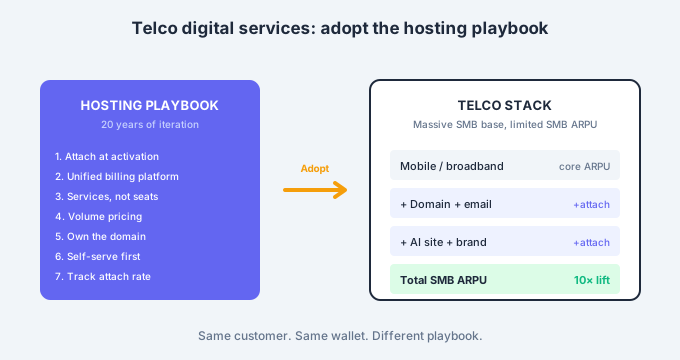
Telco digital services and hosting provider digital services should look almost identical. Both segments sell recurring subscriptions to small businesses, both bundle infrastructure with value-added services, and both compete on the same customer’s wallet share. Yet the two industries have taken almost opposite paths on SMB monetization over the last decade, and telcos are meaningfully behind on the parts hosting figured out.
We work with both segments, and the gap is neither about technology nor budget. It is about which playbooks each industry has run and which lessons have been absorbed. Hosting providers have iterated hard on SMB monetization since 2010. Telcos have iterated on network infrastructure and consumer mobile. This piece is the seven lessons hosting learned that would immediately move the needle for any telco building out its digital services roadmap.
Table of Contents
Why telco digital services and hosting are more similar than telco execs realize
The SMB customer buying a business mobile plan and the SMB customer buying shared hosting are largely the same customer. Small retail, professional services, trades, food service, coaching. They have the same wallet, roughly the same digital sophistication, and the same needs. The reason hosting providers sell them domains, sites, email, and marketing tools while telcos mostly sell them airtime, data, and maybe a security suite is not a difference in customer, it is a difference in product culture.
Hosting providers have been thinking about SMB value-added services since roughly 2001. Every year of that history has taught them something specific about attach rates, bundling, pricing, and provisioning. Telcos have that same customer in their base, at similar or larger scale, but have not run the same iteration. The result is that telco digital services ARPU on SMB is meaningfully below what the same customer produces at a competent hosting provider. That gap is the opportunity.
The gap in numbers
Publicly reported telco SMB ARPU on digital value-added services runs in the $2 to $8 per month per customer range, mostly from security bundles and cloud storage. Competent hosting providers producing SMB ARPU on the digital services stack (domain, email, hosting, website, marketing tools) run $30 to $80 per month per customer on the mature parts of their base.
That is a 10x gap, with the telco holding the larger customer base and the stronger brand. The lessons below explain what closes it.

The 7 proven lessons hosting can teach telco digital services
1. Attach at the moment of activation
Hosting providers learned early that the moment a customer registers a domain is the highest-attach moment in their lifecycle. Every other touchpoint downstream produces lower conversion, sometimes by an order of magnitude.
Telco digital services have the equivalent moment. It is when a small business activates a new line or a new plan. The customer has just made a commitment, is in a purchasing mood, and has attention available. Attach mechanics fired at that moment convert dramatically better than the same mechanics fired six months later in a marketing email. Most telcos treat activation as a fulfillment task and postpone value-added services to a separate marketing motion. Hosting learned two decades ago that this is expensive.
2. Use the billing platform, not a separate portal
Every hosting provider that has tried to run digital services through a separate portal has bounced back to running them through the main billing platform. The reason is operational. Customers do not tolerate two logins, two invoices, and two support flows for what they perceive as one relationship.
Telco digital services often run through separate portals, sometimes even through separate white-label vendors, each with its own login and billing. The operational friction on the customer side is measurable and the churn rate reflects it. Consolidating digital services back into the same billing platform the customer uses for their line is a low-cost, high-impact move that hosting figured out around 2012.
3. Sell services, not seat licenses
Hosting learned that SMBs are terrible at counting seats. Ask a five-person plumbing company how many email seats they need and the answer is unreliable. Ask them if they want business email attached to their domain and the answer is a clear yes or no.
Telco digital services still often sell on a seat model borrowed from enterprise. That model does not fit the SMB. It creates decision fatigue at purchase time and creates renewal friction as headcount fluctuates. Services priced per business, not per seat, remove both friction points. Telcos moving in this direction see attach rates rise almost immediately.
4. Price for volume, not for enterprise
Enterprise-style pricing on digital services means high margin per unit and low attach rate. Hosting-style pricing means lower margin per unit and much higher attach rate. At SMB scale, the second economics wins by a wide margin because the base is large enough that a 10 percent attach at $10 per month generates more revenue than a 1 percent attach at $80.
Telco digital services teams staffed with enterprise sales veterans tend to default to enterprise pricing, then wonder why the SMB base does not convert. The lesson from hosting is unglamorous but reliable. Volume-based pricing at commodity SMB price points produces the revenue outcome. Enterprise pricing at SMB scale produces revenue theater.

5. Own the DNS and the domain, not just the pipe
The strategic lesson hosting learned that telcos are only starting to notice: whoever owns the domain owns the customer relationship. The domain is the identity of the business online. The customer relates to their domain far more than they relate to their internet connection or their phone number.
Telcos own the pipe. They rarely own the domain. This means every meaningful digital service the SMB uses (website, email, marketing tools) lives at a URL that belongs to someone else’s ecosystem, and every renewal touchpoint on those services goes to that other ecosystem. Telco digital services that include domain registration change this dynamic. The domain becomes a telco-owned anchor for the customer’s digital identity, and every downstream service (site, email, brand kit) attaches to it naturally. Hosting has understood this for a long time. Telco is still catching up.
6. Let the customer self-serve most of it
Hosting learned that SMB customers largely do not want to talk to a support agent. They want to log in, click a few things, and see results. Support cost per active customer at a competent hosting provider is a small fraction of what it would be if every interaction ran through a human.
Telco digital services often route SMB customers through call center flows designed for consumer mobile support, which is expensive and slow. The lesson is to build the digital services portal so that provisioning, billing changes, upgrades, downgrades, and refunds all happen without human touch by default. Human support is a fallback for the edge cases. Hosting figured this out through hard operational pressure. Telcos have the operational muscle but not always the product design.
7. Measure attach rate, not just ARPU
Hosting providers have learned that the single most useful operating metric on the digital services stack is attach rate. What percentage of the base has a domain? A site? Paid email? A marketing tool? Each attach is a proxy for wallet share, and the trajectory of attach rates tells you whether the strategy is working long before ARPU catches up.
Telco digital services teams often measure ARPU as the primary metric and attach rate as a secondary one. That inversion produces slow signal. ARPU is a lagging outcome. Attach rate is the leading input. The playbook hosting has run for a decade is to obsess over the input and trust the output to follow, and it works.
What this looks like in practice for a telco
For a telco starting to run the hosting playbook on their SMB base, the practical rollout looks like this.
- Add domain registration as a line item in the standard SMB activation flow, priced accessibly, presented as part of the digital identity bundle.
- Wire a modern AI website builder into the billing platform so activation of the domain triggers site provisioning within minutes.
- Add paid business email as an upsell at activation and renewal windows.
- Track attach rates by service and by cohort, review weekly.
- Iterate the offer mix quarterly based on attach signal, not annually based on ARPU signal.
This is the playbook that took hosting a decade to figure out. Telcos can compress it into eighteen months because the tools now exist off the shelf and the playbook is documented. That is the point of writing this down.
For the technical integration side of telco digital services specifically, our platform integrations page covers the billing platforms telcos typically use. For the strategic view specific to telco partners, our telco partner page has more detail. For related economics, the registrar partner page covers the domain-attach playbook that telcos can borrow directly.
Externally, the TM Forum’s research on B2B digital services is the closest industry-standard reference for telco value-added services strategy and is worth reading for the segment-wide view.
What we hear inside telcos when the shift is discussed
Every telco we have worked with on digital services expansion goes through roughly the same internal conversation. Two objections come up consistently, and answering them is often the difference between the strategy moving forward and stalling.
The first objection is scale. Telco executives worry that a hosting-style playbook, which was designed for provider bases of hundreds of thousands, will not translate to telco bases of tens of millions. The concern is understandable and the answer is that the playbook actually scales up more cleanly than it scales down. The self-serve and platform-centralized patterns hosting learned specifically to handle large customer bases at low support cost work even better at telco scale, because the operational efficiency compounds. The objection is really a fear of the unfamiliar rather than a real economic obstacle.
The second objection is brand. Telco executives worry that a digital services roadmap positioned around domains, sites, and brand kits does not fit the telco brand, which is usually built around network reliability and consumer mobile. The answer is that the telco digital services offering does not have to be the primary telco identity. It can live as a distinct sub-brand or a partner-branded offering, integrated into the billing platform without dominating the parent brand. Hosting providers routinely run multiple sub-brands for different market segments, and telcos can adopt the same pattern.
Both objections dissolve once the conversation moves from theory to concrete rollout plans. The hard part is getting to the concrete conversation, which usually requires an executive sponsor willing to sit through the objections without letting them close the discussion.
What a realistic year-one telco digital services rollout looks like
For a telco starting from a baseline of security-and-storage as the entire digital services offering, a year-one rollout typically looks like this.
Quarter one is planning and vendor selection. The billing platform integration is scoped, the target SMB segments are defined, and the initial product bundle is designed. The organizational structure to run telco digital services is confirmed, including who owns the P&L and how the marketing team connects to the sales team.
Quarter two is the pilot. A small subset of the SMB base, usually one region or one segment, gets the offer live. The provisioning flow is tested at real customer volume. Support playbooks are refined based on actual ticket data. The attach rate is measured and reviewed weekly.
Quarter three is the expansion. Successful pilot patterns roll out to additional regions or segments. The offer mix is adjusted based on quarter-two data. The billing platform integration handles higher volume, and the marketing team learns which acquisition messages resonate.
Quarter four is the full base launch. The telco digital services offering is available to the entire SMB base, marketing spend ramps up, and the operational teams are prepared for the ticket volume of scale. By the end of quarter four, the attach rate baseline is established and the following year’s planning is anchored in real data.
Common questions from telco leadership on the SMB digital services opportunity
The two questions that come up most often in telco leadership conversations about the SMB opportunity are worth answering plainly, because they usually determine whether the strategy moves forward.
The first is whether SMB digital services can produce enough revenue to matter at telco scale. The honest answer requires context. On a per-customer basis, telco digital services will never match the mobile line ARPU. On a per-base basis, the incremental revenue is real. A one-percent lift on a ten-million SMB base is a meaningful line on the annual report, and hosting providers have shown that SMB digital services can deliver much more than a one-percent lift with proper attach mechanics.
The second is whether the telco brand risk of moving into digital services is worth the reward. The concern is that if the telco digital services offer disappoints, it reflects on the core connectivity brand. The mitigation is to run telco digital services as a distinct sub-brand or partner-branded offer, so the risk is contained. Hosting providers routinely run multiple sub-brands, and telcos can adopt the same pattern to preserve the core brand while pursuing the telco digital services opportunity.
Beyond these two questions, the pragmatic reality is that most successful telco digital services programs start with a low-profile pilot that runs for six to nine months before any brand-level commitment is made. That pilot phase produces the operational data and customer feedback that a subsequent broader launch relies on, and it lets the executive team make the brand and investment decisions with real numbers rather than projected ones.
Where to go next
Telco digital services are one of the largest untapped SMB monetization opportunities on the planet, and the playbook that unlocks them has been written already, in a different industry, over the last decade. Hosting learned the seven lessons above through iteration. Telcos can adopt them directly.
We built BrandForge to be the white-label AI brand and website platform that plugs into either a hosting stack or a telco stack, precisely because the underlying SMB monetization problem is the same.
- If you are a telco building a digital services roadmap, start with the telco partner page.
- For a walkthrough of the technical integration, see the platform integrations overview.
- To have the strategic conversation with our team, use the demo request page.
Telco digital services do not need to reinvent SMB monetization. The playbook exists. Run it.
