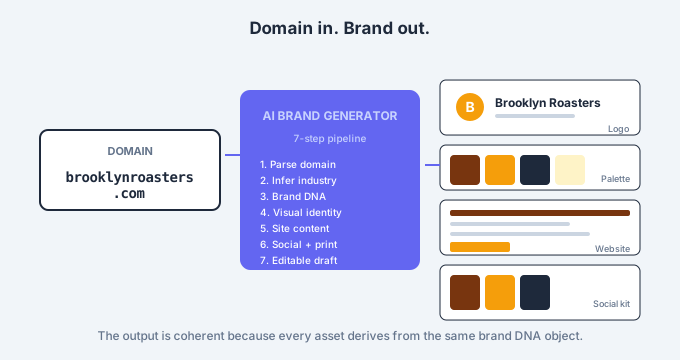
An AI brand generator sounds like a magic box. Type in a domain name, wait a few seconds, get a logo, a color palette, a website, and a social media kit. In practice there is no magic. There is a fairly specific sequence of seven steps happening inside the box, and each one has ways it can go right or wrong. This piece opens the box.
We built the AI brand generator inside BrandForge and we have spent two years watching what makes the output good versus mediocre. The difference is almost never the model. It is the sequence of steps and the prompts feeding into each one. Understanding the seven steps helps two audiences: hosting providers evaluating an AI brand generator for their reseller stack, and small business owners who want to know why the output looks the way it does.
Table of Contents
What an AI brand generator actually is
An AI brand generator is a system that takes a small amount of input (typically a domain name plus a one-line description) and produces a full brand identity kit: name treatment, logo, color palette, typography, tagline, website copy, and matching social and print collateral. The kit is coherent, meaning every artifact reflects the same underlying brand system, not a collection of unrelated outputs.
Two things distinguish a modern AI brand generator from a template-based tool. First, the entire kit is derived from the specific business rather than selected from a library of pre-made options. Second, the artifacts share a common brand DNA object, so changes to the underlying identity propagate to every derived asset. That coherence is the technical achievement, and it is what makes the output feel like a real brand rather than a scrapbook.
Why the domain name is the right starting point
The domain name is the most information-dense thing a small business owner will give you at the start. It contains the business name, often an industry hint, sometimes a location, and always the linguistic register the founder chose. A domain called “brooklynroasters.com” tells you more, quicker, than a form with ten fields.
The domain is also the moment of highest intent. The customer has just committed money and mental energy to the name. Everything downstream, the site, the brand, the launch, is easier if it starts from that moment. An AI brand generator that runs on the domain purchase is meeting the customer where their attention already is.
The remaining question is what to do with that starting point, which is where the seven steps come in.
The 7 proven steps inside a modern AI brand generator
Each step below is a specific operation, not a marketing phase. If any of them is missing or weak, the final output shows it, usually in ways the customer can name even if they cannot diagnose.
1. Parse the domain name into signal
The domain name gets tokenized and analyzed. Words are separated (“brooklynroasters” becomes “brooklyn” and “roasters”), meaning is extracted, and any conventions in the naming (geography, industry noun, invented word) are noted. This step is not glamorous but it sets the direction for everything downstream.
A weak AI brand generator treats the domain as a string of characters. A strong one recognizes that “brooklynroasters” is a coffee business in a specific neighborhood in New York, and that “roasters” implies craft rather than chain. Those inferences drive every subsequent step. The quality of parsing at step one is the single biggest predictor of whether the final brand feels specific or generic.
2. Infer the industry and audience
From the parsed signal, plus any short description the customer added, the AI brand generator infers the specific industry, the likely audience, the price point, and the aesthetic sensibility. Brooklyn Roasters is coffee, but it is not Starbucks coffee. It is closer to Blue Bottle or Stumptown: a specialty roaster serving customers who care about origin, roast profile, and craft.
That inference cascades. Specialty coffee implies certain typography choices, certain color palettes, certain copy voice, and certain image sensibilities. Get the inference wrong at step two and every downstream artifact fights the customer’s actual brand. Get it right and the artifacts land close to what the customer would have briefed a human designer to make.

3. Generate the brand DNA object
The brand DNA is the canonical object every downstream artifact derives from. It contains the brand’s essence: personality traits, core values, tone descriptors, visual keywords, target audience profile, and positioning statement. A typical brand DNA object has twenty to forty structured attributes.
This is the object that makes the coherence possible. When the logo, the site, the social kit, and the print assets all reference the same brand DNA, they end up feeling like the same brand. When they are generated independently from the domain, they diverge in style, tone, and personality. Every serious AI brand generator has some version of a brand DNA object even if the vendor does not name it that way. The ones that skip it produce outputs that feel visually related but not conceptually related, which is a subtle but perceptible failure.
4. Derive the visual identity
From the brand DNA, the AI brand generator derives the visual identity: color palette, typography pairing, logo concept, image style, and iconography. Each of these is a constrained generation, meaning the model is picking within a specific range determined by the brand DNA rather than exploring the whole space of possibilities.
Constrained generation is important because unconstrained visual output tends toward the average. If the model just generates whatever looks like a coffee brand, you get a beige-and-brown latte-art aesthetic that fits half the coffee brands on the internet. Constrained generation based on a specific brand DNA produces something more particular. Brooklyn Roasters might land on a bolder, more industrial palette, with a display font that reads craft rather than corporate. The visual identity feels made for that business.
5. Compose the website content
Website content follows from the visual identity and the brand DNA. The hero copy, the services description, the about section, the calls to action, all get generated with the voice and specificity the brand DNA implies. This is not filler content. It is the actual site copy the customer will edit.
The quality bar at this step is that a small business owner should be able to read the generated copy and think, “yes, that’s close, I just want to change a few things.” If the copy triggers “no, I would never say that,” the AI brand generator has missed the voice. Modern generators clear this bar reliably for straightforward businesses (coffee, dentist, yoga studio, consulting). They still miss on niche or highly specialized businesses (medical device consulting, legal specializations, industrial B2B), which is why the customer’s ability to refine remains essential.
6. Render matching social and print assets
Social profile images, cover photos, business card designs, letterhead, and any other collateral derive from the same visual identity. The consistency matters because a small business will use these assets across many surfaces, and inconsistency shows up as a lack of professionalism.
An AI brand generator that produces a great website but a mediocre social kit forces the customer to hire someone to fix the social kit, which defeats the purpose. A strong AI brand generator produces a consistent set of assets that work together out of the box, with the customer’s control focused on refinement rather than reconstruction.
7. Present a coherent editable draft
The final step is presentation. All the generated artifacts arrive in an interface where the customer can review, edit, and iterate. The interface has to make the brand DNA visible enough that the customer can adjust it (make the tone more playful, shift the color palette warmer, change the target audience) and see the whole kit update in response.
This step is where directive editing matters. The customer should be able to say what they want in words and see the kit respond, not have to manipulate individual artifacts one at a time. A well-designed AI brand generator presents an editable brand rather than an editable set of files.

Common failure modes and how to spot them
Four failure modes recur across weaker AI brand generators. Spot them in a demo and you know the underlying pipeline is thin.
- Generic imagery. Every business gets stock-looking output. This means either the parsing step is failing or the inference is defaulting to a broad category.
- Style drift. The logo is modern, the site is retro, the social kit is corporate. This means there is no shared brand DNA object; each artifact was generated independently.
- Copy that reads like filler. “Welcome to our website” or “We provide the best service.” This means the model is either not receiving the inferred audience or is receiving it but ignoring it.
- No obvious way to edit the underlying brand. The customer can change individual pieces but not the direction. This means the brand DNA exists only implicitly, not as a manipulable object.
Any AI brand generator serious about being used at scale will avoid all four. Ones with even one of these failure modes will produce customer frustration at production volumes.
What makes one AI brand generator better than another
The interesting differentiator is not the underlying image model or language model. Everyone has access to roughly the same frontier models. The differentiator is the pipeline structure, the prompts, and the brand DNA schema.
- Parsing depth. How much information the generator extracts from the domain name and short description.
- Inference quality. How specific the industry and audience conclusions are.
- Brand DNA schema. How many structured attributes the brand DNA object contains, and how those attributes propagate to downstream artifacts.
- Constraint discipline. How tightly the visual and copy generation are constrained by the brand DNA rather than exploring the full model space.
- Editability. How exposed the brand DNA is to customer editing versus locked behind the interface.
Evaluating an AI brand generator on these five axes is much more predictive than comparing sample outputs. Samples show what the vendor picked to show. The pipeline structure shows what the vendor can consistently produce.
For a walk-through of how our brand DNA object works inside BrandForge, and how it drives the logo generator, see the linked feature pages. For the strategic framing on why this category matters, our post on the AI brand builder as a new category covers the argument in more depth.
Externally, Interbrand’s Best Global Brands methodology is the closest thing the industry has to a shared frame for what “brand” actually means, and it is worth reading if you want a reference point for what an AI brand generator is trying to approximate at small business scale.
Where to go next
An AI brand generator that runs on a domain purchase is the fastest path from “I have an idea” to “I have a brand” that has ever existed. The catch is that not every AI brand generator does the seven steps well. Weak pipelines produce forgettable output. Strong pipelines produce output a small business owner can actually launch with.
We built the AI brand generator inside BrandForge with the seven steps as the explicit architecture, precisely because we knew the pipeline mattered more than any single model.
- If you want to see the generator in action, try the BrandForge demo.
- If you want the product-level view of the brand DNA and logo generation, start with the brand DNA feature page.
- If you are a hosting or registrar partner evaluating for the reseller channel, book time via the demo request page.
Every AI brand generator is a set of seven steps. The good ones do all seven with intention. The rest just guess.