The auDA board has accepted a policy recommendation that will make more than a million .com.au and .net.au domains technically ineligible under current registration. If your domain is held by a trust, if it does not match your company name exactly, if it is a product name rather than a business name, if it is a misspelling of your brand, or if it was picked up as part of a business acquisition and the original entity has since lapsed, you have a problem you need to solve.
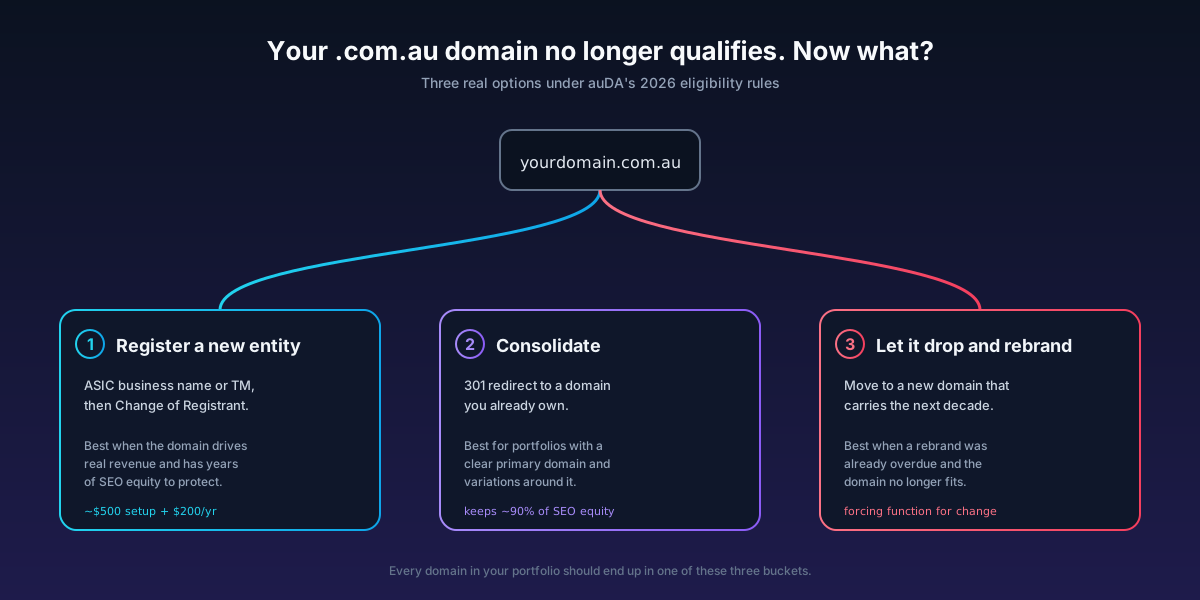
You have three real options. Which one is right depends on the domain’s commercial value to you, the cost of maintaining eligibility, and whether you have somewhere better for that traffic to go.
Table of Contents
Option 1: Register a new entity to keep the domain
The path of least resistance if the domain is genuinely valuable and central to your business.
You register a new business name with ASIC (roughly $44 for a year, $102 for three years, plus accounting fees to keep it active on your books) or you file a trade mark (around $250 to $600 in filing fees plus $1,500 to $3,000 in legal fees if you use a professional). Then you perform a Change of Registrant on the domain, moving it from your current entity to the new one that matches.
When this makes sense. The domain is generating real revenue or leads. It has years of SEO equity and backlink authority you cannot afford to lose. Its exact-match value cannot be replicated with a rebrand. You have multiple domains you can consolidate onto it later.
When it does not. You own the domain out of sentimentality or “just in case”. You are already thinking about rebranding for other reasons. The domain does not drive measurable business value. You have five or ten of these and the recurring cost is going to be significant.
The trap here is registering a business name that exists only to hold the domain. It is not illegal, but auDA has signalled that they may scrutinise entities that appear to be shells. Do not park your registrations behind an obviously fake business name and expect no follow-up.
Option 2: Consolidate onto a domain you already own
This is the option most .com.au portfolio holders should be considering, and the one most under-discussed in the current coverage.
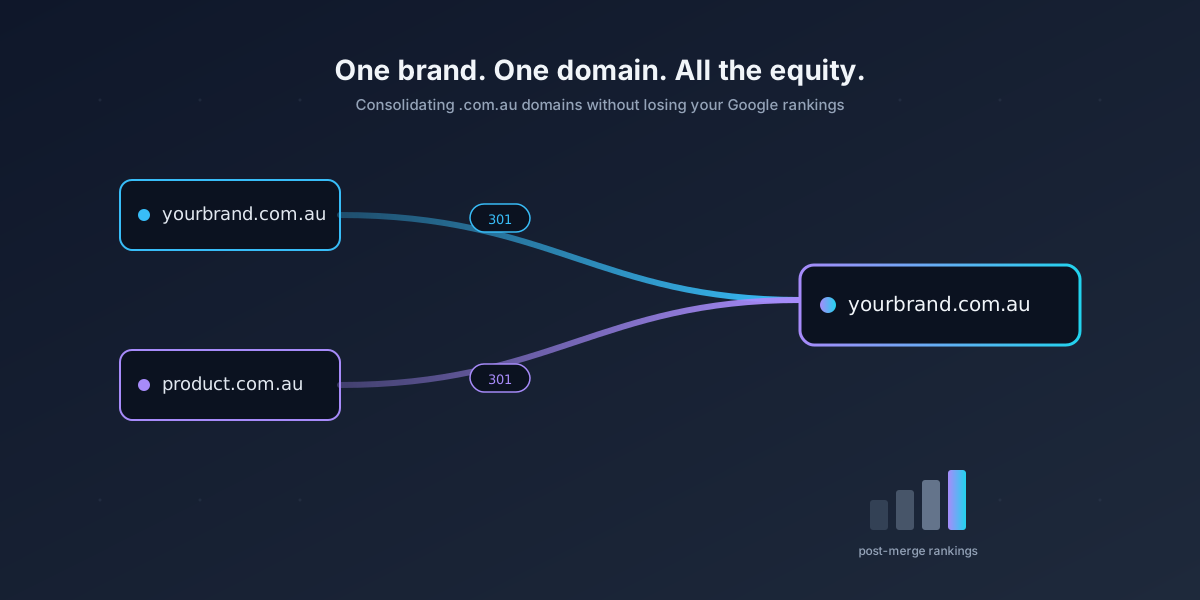
If you own several domains and one of them is your primary trading identity, redirect the rest to it. You keep the SEO equity through proper 301 redirects, you eliminate the recurring cost of maintaining multiple eligibilities, and you concentrate your brand instead of spreading it thin.
When this makes sense. You have a clear primary domain that is unambiguously eligible. Your secondary domains are variations, misspellings, product-specific, or campaign-specific. The traffic across your portfolio is heavily concentrated on one or two domains anyway. You would rather spend the maintenance budget on marketing than on ASIC filings.
When it does not. The secondary domain has strong direct traffic that would not naturally find the primary. The secondary domain serves a genuinely different audience or brand. You are actively operating multiple businesses under separate identities.
The technical work is straightforward if you follow a proper migration process: crawl every URL, map source to destination, implement 301s at the server level, submit change of address in Search Console, update internal links, rebuild off-site citations. Done right, you keep 90 percent of the traffic and often gain from the consolidation of authority.
Option 3: Let it drop and rebrand
The nuclear option, and sometimes the right one.
If a domain is not commercially critical, not driving meaningful traffic, and not worth the recurring cost of eligibility, let it lapse. Or if you have been meaning to rebrand anyway and the domain no longer fits, use the auDA change as the forcing function to do it now.
When this makes sense. The domain is a legacy asset you have been paying for out of habit. Your brand has evolved and the domain no longer represents it. You are moving to a new gTLD (.au directly, .co, .ai, whatever fits) as part of a bigger repositioning. The cost of eligibility across your portfolio exceeds what any single domain is generating.
When it does not. The domain is generating any real revenue or has significant backlinks pointing to it. It is a premium generic that would be caught immediately by drop-catchers and used against you. You have any customer touchpoint (invoices, printed material, email signatures) still actively using it.
If you go this route, do it properly. Announce the change to your customer base, migrate every touchpoint, redirect for at least 12 months before letting the domain drop, and take the opportunity to rebuild your brand around a domain and identity that will carry you for the next decade rather than the last one.
A simple decision framework
Ask yourself four questions in order:
- Is this domain generating measurable revenue or lead volume? If yes, go to question 2. If no, jump to option 3.
- Do I already own a stronger domain that could absorb this one’s traffic? If yes, option 2 is your default. If no, go to question 3.
- Is the cost of a new entity (roughly $500 to $1,000 setup plus $200 to $400 per year) less than 10 percent of the annual value this domain generates? If yes, option 1 makes sense. If no, options 2 or 3 are better.
- Would I still register this domain today if I were starting from scratch? If no, option 3. If yes, options 1 or 2.
Run every domain in your portfolio through this quickly. You will probably find that 20 percent are worth Option 1, 60 percent belong in Option 2, and 20 percent should be Option 3. The exact split depends on your portfolio, but very few businesses will find that all their domains deserve the eligibility investment.
What NOT to do
Do not wait. Registrars will begin enforcement, and complaint-driven takedowns are a real risk. Someone can whois-check your domain, notice the mismatch, and file a complaint that puts your domain into a policy-delete queue.
Do not blanket redirect everything to your homepage. If you go with Option 2, you need proper URL-level 301 mapping. A blanket redirect looks like a soft 404 to Google and destroys the ranking equity you are trying to preserve.
Do not register a shell business name for a domain you were going to let drop. If the honest answer is you do not need the domain, do not spend $650 a year to keep something that will not earn its keep.
Do not assume your registrar will handle this for you. They will notify you, but they cannot make the decision or perform a Change of Registrant on your behalf. This is on you.
Where BrandForge fits
If you land on Option 2 or Option 3 and the surviving or new domain needs a brand identity that ties everything together, that is what BrandForge is built for. Generate a new visual identity, website, and asset kit in an afternoon. When the auDA rules are forcing hundreds of thousands of businesses through a rebrand-adjacent decision at the same time, having a fast, cheap way to execute the visual side of it is genuinely useful.
The policy change is bad. The opportunity underneath it, to simplify your portfolio and concentrate your brand, is real. Pick the option that fits each domain and get moving before your registrar’s queue clogs up.
FAQ
What actually changed?
The auDA board accepted a Policy Advisory Panel recommendation to delete subparagraph (f) from section 2.4.4(2) of the .au Licensing Rules. In plain English: the “name of a service, goods, event, activity or premises” is no longer an acceptable basis for holding a .com.au or .net.au. Going forward, the domain has to be a match or acronym of a registered business name, company name, or trademark held by the registrant.
How many domains are affected?
Industry estimates put it at over a million .com.au and .net.au domains, with some estimates as high as two million. That’s roughly a third of the namespace.
Is this live now?
The board approved the recommendations in principle in August 2026. auDA has been directed to prepare an implementation plan. Registrars are already tightening compliance checks at renewal, and complaint-driven takedowns are a real risk right now even before formal enforcement kicks in.
My domain is held by a trust. Am I affected?
Yes. Trust-held domains without a matching business name or trademark are in scope.
My domain doesn’t exactly match my company name. Am I affected?
If it’s not a match or acronym of your registered entity or trademark, yes.
My domain is a product name, not a business name. Am I affected?
Yes. That’s precisely the category being removed.
My domain is a common misspelling of my brand. Am I affected?
Yes, unless the misspelling itself is a registered business name or trademark you hold.
Will my registrar handle this for me?
No. They’ll notify you, but they can’t make the decision or perform a Change of Registrant on your behalf. This is on you.
How urgent is this?
Urgent enough that waiting is the wrong move. Complaint-driven takedowns can already put a domain into a policy-delete queue. Registrar queues will clog as enforcement ramps up.
How do I decide across a whole portfolio?
Run each domain through four questions:
1. Does it generate measurable revenue or leads? If no, jump to Option 3.
2. Do you own a stronger domain that could absorb its traffic? If yes, Option 2 is your default.
3. Is the cost of a new entity (roughly $500 to $1,000 setup plus $200 to $400 per year) less than 10% of the annual value the domain generates? If yes, Option 1 works.
Would you register this domain today from scratch? If no, Option 3.
For most portfolios, roughly 20% of domains earn Option 1, 60% belong in Option 2, and 20% should be Option 3.
Won’t I lose SEO if I redirect?
Not if you do it properly. Crawl every URL, map source to destination, implement 301s at the server level, submit a change of address in Search Console, update internal links, and rebuild off-site citations. Done right, you keep around 90% of the traffic and often gain from consolidated authority.
Can I just blanket-redirect everything to my homepage?
No. Google treats blanket redirects as soft 404s and you lose the ranking equity you were trying to preserve. URL-level mapping is not optional.