AI brand consistency is the hardest problem in generative brand tooling. Generating a good logo is straightforward. Generating a good website is straightforward. Generating a good social media kit is straightforward. Getting all three to feel like the same brand, across the same customer’s entire kit, is where most tools fall apart. The output looks related in the way three shirts from the same store look related, but not in the way one brand’s actual identity should feel unified.
We work on AI brand consistency every week inside BrandForge, and after two years of iteration the pattern is settled. Six specific techniques account for almost all the difference between a tool that produces coherent output and one that produces a scrapbook of loosely related assets. This piece walks through each of them.
Table of Contents
Why AI brand consistency is harder than it looks
The naive approach to AI brand consistency is to feed the same prompt into every generation step: “modern coffee brand, warm palette, artisanal feel.” That approach produces output that has surface consistency but no deep consistency. The logo might be modern and warm, the website might be modern and warm, the social kit might be modern and warm, but there is no shared object that ties them together. Change the site’s palette and the logo does not update. Refine the social voice and the site copy does not follow.
Real AI brand consistency requires that every artifact reference a shared, editable brand object, and that changes to that object propagate through every downstream generation. That is a much harder engineering problem than producing three related-looking things from three related-looking prompts, and it is where most generative brand tools fail quietly.
What breaks first in a naive generator
Before the six techniques, a quick tour of what fails and how. If you are evaluating an AI brand generator, look for these symptoms in the output.
- Palette drift. The logo uses one warm brown. The site uses a different warm brown. The social template uses a third. Superficially all warm brown, actually three different color values that would fail any brand guidelines review.
- Voice inconsistency. The site copy is warm and personal. The social captions are terse and corporate. The email templates read like a template. The customer sees three different brands trying to be one.
- Style-per-artifact. Each asset was generated independently with a fresh interpretation of the brief, so the aesthetic mood shifts between them. Modern here, retro there, corporate elsewhere.
- Broken update chains. The customer refines the brand direction in the editor and nothing downstream changes. New content still generates against the old brief.
All four symptoms come from the same root cause: no shared canonical brand object. AI brand consistency starts with fixing that.
The 6 proven techniques for AI brand consistency
1. Anchor every artifact to a shared brand DNA object
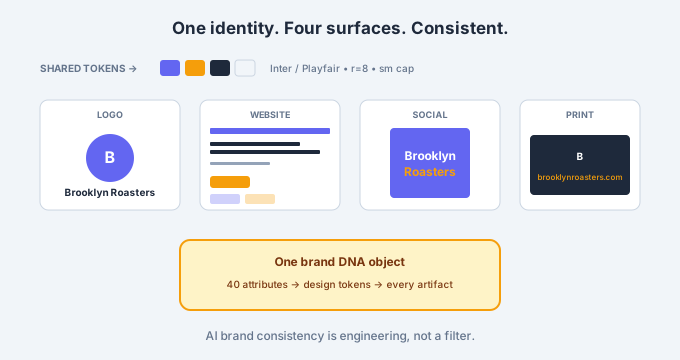
The single most important technique. Every generation step in the pipeline reads from the same brand DNA object. Logo generation reads it. Site generation reads it. Social kit generation reads it. Copy generation reads it. Print asset generation reads it. If the brand DNA says “warm, artisanal, understated,” every artifact reflects that combination rather than each artifact making an independent interpretation.
The brand DNA object needs to be structured, not free text. Typical schemas include twenty to forty attributes: personality traits, tone descriptors, visual keywords, audience profile, color mood, typography direction, imagery style. The more structured the schema, the more precisely each downstream generation can reference it, and the tighter the resulting AI brand consistency.
2. Extract design tokens, not just style descriptors
Style descriptors like “warm and modern” are useful but not precise enough for tight AI brand consistency. Design tokens are precise. A design token is a specific value: a hex color, a font family, a spacing scale, a border radius, a specific icon set. Once the brand DNA has been generated, the next step is to derive the design tokens from it, and every subsequent artifact uses those exact tokens rather than reinterpreting the descriptors.
The distinction matters because reinterpretation is where AI brand consistency breaks. If the logo generator interprets “warm brown” as #78350f and the site generator interprets it as #92400e, they are visually similar but technically different, and no brand system tolerates that. Extracting the token once and referencing it everywhere eliminates the drift.

3. Constrain generation by budget, not just by prompt
Generative models tend toward the average of their training distribution when unconstrained. Even with a good prompt, the model will sometimes produce output that drifts toward the popular aesthetic rather than the specified one. The technique that fixes this is to constrain the generation budget: fewer degrees of freedom, more explicit references to fixed design tokens, and hard constraints on which parts of the output can vary.
For a logo, that might mean fixing the color palette and typography and only letting the model vary the mark itself. For a site section, that might mean fixing the layout structure and only letting the model vary the copy and imagery selection. Tight constraint budgets produce narrower output, which is exactly what AI brand consistency requires. The customer does not want fifteen wildly different logo options. They want the right logo, produced within the constraint of the brand DNA.
4. Regenerate downstream when upstream changes
If the customer changes the brand DNA (for example, by shifting from “artisanal” to “sleek and modern”), every downstream artifact needs to update. Naive generators produce the initial kit, then treat each artifact as independent going forward. Any customer refinement to the brand only affects the artifact they are directly editing. This is the fastest way to destroy AI brand consistency.
The right pattern is that the brand DNA is the source of truth, and downstream artifacts are views into it. When the source changes, the views regenerate. The customer edits the brand, and the site, logo, and social kit all update to reflect the new direction. This is technically demanding because it requires careful diff tracking and change propagation, but it is what makes the brand feel like a living identity rather than a static kit.
5. Use the same voice model for every piece of copy
Copy is where AI brand consistency subtly breaks. Site copy, social captions, email subject lines, ad headlines, and print collateral are all generated at different moments, sometimes months apart. If each generation uses a fresh interpretation of the brand voice, the voice drifts over time even when the visuals stay consistent.
The technique that fixes this is to encode the voice as an explicit, reusable component. Voice descriptors, sample phrases, tone rules, and forbidden phrasings live in a voice document that every copy generation references. When the customer adjusts the voice, the voice document updates, and all future copy respects the new rules. This is the AI brand consistency equivalent of a style guide, and it works the same way.
6. Include the customer in the consistency loop
The last technique is less technical but no less important. The customer knows their brand better than any model can, and their edits contain information the pipeline should learn from. When the customer changes the tagline, the pipeline should notice that “the customer prefers shorter and more direct” and apply that pattern to future generations. When the customer swaps out an image, the pipeline should register the aesthetic preference and use it downstream.
This is not a research-frontier capability. It is careful UX and prompt engineering that treats customer edits as brand DNA updates, not as one-off overrides. Tools that do this well produce output that gets tighter over time as the customer’s preferences accumulate. Tools that do not treat every session as a fresh start, which means AI brand consistency degrades rather than improves with use.

How to test whether a tool actually delivers AI brand consistency
Four tests separate real AI brand consistency from marketed AI brand consistency.
- Generate a full kit, then read the color values. Are the same brand colors used everywhere as exact hex values, or are they visually similar but technically different across artifacts?
- Edit the brand direction after initial generation. Do downstream artifacts regenerate, or do only the artifact you edit change?
- Compare copy across surfaces. Does the tagline, the site copy, the email templates, and the social captions all sound like the same voice, or like three different writers?
- Refine an image manually. Does the pipeline learn from that refinement, or is the next generation just as generic as the first?
Any tool that passes all four is treating AI brand consistency as a first-class engineering problem rather than a marketing feature. Any tool that fails on more than one is producing output that will accumulate consistency debt at production scale.
Trade-offs and edge cases
For fairness, three trade-offs worth acknowledging.
- Tight AI brand consistency reduces creative range. Constraining every artifact to the brand DNA means the customer sees less variation. That is what the customer usually wants, but a designer sometimes finds it restrictive. This is fine for the small business segment and less fine for high-end custom work.
- Regeneration on upstream change can be expensive. If every brand DNA edit triggers regeneration of ten downstream artifacts, the inference cost adds up. Smart tools batch and defer regeneration to keep cost manageable while preserving consistency.
- Voice consistency across languages is genuinely hard. The brand voice in English does not always translate cleanly. Multi-language AI brand consistency is a real research problem, and current tools handle it with varying success.
None of these trade-offs are dealbreakers. They are just honest limits of the current generation of AI brand consistency tooling.
For a walkthrough of how our brand DNA object handles the six techniques above, and how it integrates with the logo generator and social media co-pilot, see the linked feature pages. For the strategic frame, our post on the AI brand builder as a new category covers why this is a category-defining problem.
Externally, Nielsen Norman Group’s writing on design systems is the closest thing to a canonical reference for how design tokens should be structured, and much of it applies directly to AI brand consistency.
Where to go next
AI brand consistency is the difference between a generative brand tool that a small business will actually use across their whole business and one that produces a nice-looking initial kit which then falls apart on second use. It is not a nice-to-have feature. It is what makes the generated brand real.
We designed the BrandForge pipeline around AI brand consistency from the start, because we knew from the beginning that a small business needs one brand across ten surfaces, not ten disconnected artifacts.
- To see the consistency in action, use the BrandForge demo.
- If you want the product-level view, start with the brand DNA feature page.
- If you are a partner evaluating for reseller distribution, book time via the demo request page.
AI brand consistency is a solved problem when the pipeline is designed for it, and an intractable problem when it is not. Choose tools that have designed for it.