Every registrar executive we meet has the same spreadsheet. Domains under management on one axis, ARPU on the other, and a horizon line that has barely moved since 2015. Registrar ARPU has been stuck between $10 and $18 per year per domain for a decade, and the industry has treated that as a physical constant. It is not. It is a symptom of a specific set of missing attach mechanics that the market now knows how to fix.
The registrars we see moving right now are not adding more domain suffixes or squeezing more margin from wholesale. They are attaching real recurring services to the domain, and their registrar ARPU is heading toward $150 per year on average, with some segments well above that. The move takes eighteen months to complete, but the direction is settled. This piece is about the six mechanics that actually make the number move.
Table of Contents
What registrar ARPU actually measures
Registrar ARPU is the average revenue a registrar recognizes per active domain per year. In most public filings it is calculated as total revenue divided by domains under management, though internally most registrars break it into new registration ARPU, renewal ARPU, and attach ARPU.
The interesting number is attach ARPU. New registration and renewal revenue is roughly fixed by the wholesale fee structure and competitive pricing pressure. Attach ARPU is where the leverage sits, and it is the component that has moved the least across the industry over the last decade despite the largest available upside.
Why the $12/year ceiling exists in the first place
The ceiling is not a market limit. It is a product limit. Registrars historically had three attach products: SSL certificates, privacy protection, and email hosting. All three peaked years ago. SSL is free from Let’s Encrypt. Privacy is now included by default at most competitive registrars. Email hosting is a low-margin commodity dominated by Google and Microsoft.
That left the registrar with no genuinely new attach category since around 2016. Meanwhile the small business customer buying a domain went from being a hobbyist or developer to being an actual business owner with real budget for real services. The customer changed. The product shelf did not. The ARPU gap is the size of that mismatch.
The good news is that the missing category has finally arrived. AI-generated websites, brand kits, and marketing assets are attachable at the moment of registration, priced at $10 to $100 per month, with margins that resemble software rather than commodity hosting. Six moves make that new category actually flow into registrar ARPU.

The 6 proven moves that lift registrar ARPU
Each of these moves has been implemented at real registrars, at real scale, with measurable effects on registrar ARPU. They are ordered by ROI per week of engineering effort, which is close to but not identical to raw revenue impact.
1. Convert the parking page into a starter site
The default post-registration experience is a parking page. It converts nothing, and it advertises the registrar rather than the customer. Replacing it with a real, AI-generated starter site at the customer’s own domain is the highest-ROI change available for lifting registrar ARPU.
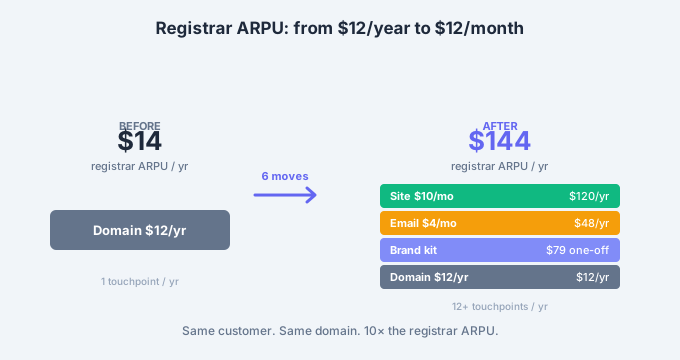
The mechanic is simple. Every newly registered domain resolves to a lightweight page that presents itself as the customer’s own site, with the domain name in the header and a call to action to publish. A percentage of customers, typically 3 to 6, convert to a paid site plan within the first thirty days. At $10 per month, that alone adds $4 to $8 to the registrar ARPU curve per new domain sold, spread across the full base.
2. Bundle a brand kit with every new registration
The registration moment is the highest-intent moment the customer will ever have. They just paid for a name and are already thinking about what the name represents. That is the moment to offer a brand kit: logo, colors, social profile images, and a starter site, priced as a one-time $59 to $99 bundle.
Attach rates on brand kits at the registration moment run 6 to 12 percent in practice, which is a meaningful lift to registrar ARPU on its own. The one-time nature is fine. Registrar ARPU calculations are usually normalized to annual, and even a one-time attach of $79 spread across every new registration adds several dollars to the average. Compounded across a base of hundreds of thousands of domains, the effect is real.
3. Move from annual to monthly billing
Domain fees are inherently annual because registries invoice registrars annually. But the attach products do not have to be. The single biggest structural change we recommend to lift registrar ARPU is separating the billing cycle of attach products from the domain cycle.
A customer paying $12 for a domain and $10 per month for a site attached to it is billed $132 across the year in twelve small charges rather than one large one. The registrar ARPU lift is 11x on that customer relative to the domain alone. More importantly, the monthly billing creates twelve touchpoints per year rather than one, and each touchpoint is an opportunity to upsell, notify, or re-engage. That is a completely different customer relationship than the traditional once-a-year renewal.
4. Introduce a domain-attached email tier that is not free
Free email hosting became standard because it was a competitive necessity a decade ago. It is now a moat that traps registrar ARPU below where it should be. The email product has value, and giving it away signals that all the other attached services should also be free.
The move is not to charge for the free tier. The move is to add a genuinely better paid tier at $4 to $8 per mailbox per month that includes real features: proper spam handling, DKIM, DMARC, decent web UI, mobile sync, calendar. Attach rates on paid email at the registration moment run 5 to 10 percent when the free tier stays in place. That is another two to four dollars per registration flowing into registrar ARPU, and the customer segments that pay for email are the ones who also pay for everything else.

5. Sell the second year at registration time
Most registrars sell a one-year domain by default, with an option for multiple years hidden in a dropdown. That default costs registrar ARPU in two ways. First, it makes the initial transaction smaller than it needs to be. Second, it exposes the customer to the annual churn window every twelve months instead of every twenty-four or thirty-six.
Making a two-year default at registration lifts registrar ARPU immediately, because more customers just accept the default than deliberately switch to one year. It also cuts effective churn roughly in half, because the customer only has to decide to leave every two years instead of every one. Both effects compound. This is the move with the highest ratio of benefit to implementation cost, since it is a UI change and a small pricing update rather than a product build.
6. Rescue churners with a build offer, not a discount
The traditional churn rescue is a coupon on the renewal. Fifty percent off the next domain year. That works to save some customers, but it destroys registrar ARPU on the ones it saves because it locks them into a permanently discounted price expectation.
A better move is to intercept the churn signal with a build offer instead. The customer is about to cancel because the domain never became anything. Offer them a starter site, free or heavily discounted for the first three months, that turns the domain into something visible. A meaningful fraction of would-be churners take the offer, keep the domain, and pay full renewal price the following year. Registrar ARPU stays intact and the customer becomes a recurring site subscriber. Both metrics move in the right direction, and neither is achieved by the discount rescue.
The compounding effect
None of these six moves are enormous on their own. Together they compound. Here is roughly how the math plays out for a mid-sized registrar with 500,000 domains under management, starting from a baseline registrar ARPU of $14.
- Move 1 (starter site attach) adds around $6 to registrar ARPU across the base within eighteen months.
- Move 2 (brand kit at registration) adds around $5, weighted by new registration share.
- Move 3 (monthly billing on attach) does not add to registrar ARPU directly, but it turns the customers who did attach into much more valuable ones, indirectly lifting the average by another $8 within a year.
- Move 4 (paid email tier) adds around $3.
- Move 5 (two-year default) adds around $2 in effective registrar ARPU through reduced churn.
- Move 6 (churn rescue with build) adds around $2 through retention and attach recovery.
Total lift: from $14 to roughly $40 in the first year and toward $100 by year three as the mix of active attach customers matures. That is the shape of the registrar ARPU curve when the six moves compound properly.
What to measure and how to know it is working
Registrar ARPU is the outcome metric, but it lags the inputs. The four input metrics we track and recommend every partner track are:
- New registration attach rate. Percentage of newly registered domains that attach a paid site, brand kit, or paid email tier within the first thirty days.
- Renewal window attach rate. Percentage of pre-renewal contacts that add a new recurring service during the sixty-day pre-renewal window.
- Effective churn rate. Percentage of the base that lapses per year, weighted by whether they had attached services or not.
- Two-year default acceptance. Percentage of new registrations that accept the two-year option when it is the default.
Watching these four moves the registrar ARPU number well before it shows up in quarterly reporting.
For a walkthrough of the specific attach mechanics that make Moves 1 and 2 practical, the BrandForge website builder feature detail covers the domain-to-site provisioning flow. For the specific registrar partner economics, our registrar partner page has more detail on how these moves map to the registrar’s billing platform.
Externally, ICANN’s domain industry report is the standard reference for registrar economics and includes the industry-wide ARPU and renewal statistics that make the baseline picture concrete.
Where to go next
Registrar ARPU has been the industry’s flat metric for a decade. It does not have to stay flat. The tooling required to attach real recurring services at the moment of registration exists now, priced accessibly, integrated into the billing platforms registrars already use.
The registrars who make the move in 2026 are going to open a permanent gap on the registrars who do not. That gap will compound. Once a customer is paying $12 per month rather than $12 per year, the churn dynamics, the customer relationship, and the operational model all change in ways that are very hard to reverse from behind.
We built BrandForge specifically to plug into a registrar’s stack and make the six moves above operationally cheap. The AI generation, brand kit, and billing integrations are already there. The remaining work is on the registrar side, sequencing the moves so that operational load stays manageable while registrar ARPU rises.
- If you want the strategic conversation with our team, use the demo request page.
- If you are evaluating specifically for a registrar business, start with the registrar partner page.
- For the shorter product view, features overview covers what the platform actually does.
The registrar ARPU curve is going to bend upward in this cycle. The question is which registrars bend it first.