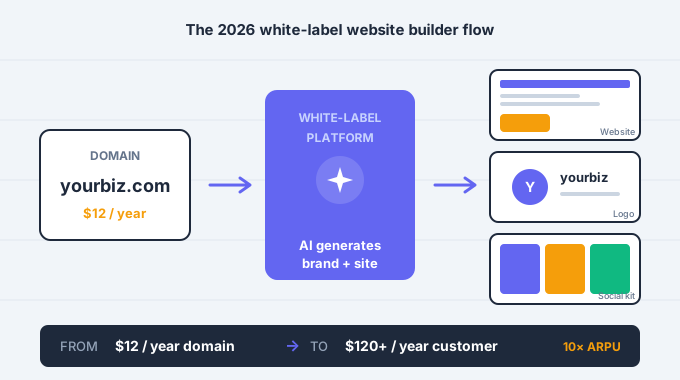
A white-label website builder used to be a nice-to-have. A checkbox in the upsell menu next to SSL certificates and email hosting. In 2026, it is closer to the difference between a $12 domain sale and a $120 customer relationship. Registrars, hosts, telcos, and MSPs are all figuring this out at roughly the same time, and the market is starting to sort winners from losers.
We built BrandForge because the tools our partners were offering had not moved in five years. Templates, drag-and-drop, and a control panel bolted onto WHMCS. The end user was still expected to design a site. Meanwhile the small business buying a domain wanted a site the moment the payment cleared, and would happily pay more to skip the work.
This piece is the checklist we wish we had when we started. It is what a serious white-label website builder needs to do in 2026 if a hosting provider or registrar wants to sell it without embarrassment. Nine points, in the order we would test them, with a note at the end on what to safely ignore when a white-label website builder vendor pitches you a hundred-item feature list.
Table of Contents
Why the hosting website builder question changed
For most of the last decade, hosting providers treated the builder as an SSL. Something you sold as an add-on for a few dollars a month, from a menu of three or four vendors, all of them roughly the same. The end user did the work. You collected a small margin.
Three things broke that model.
First, the small business customer changed. According to W3Techs data on content management systems, the long tail of CMS platforms is fragmenting, and the buyers of shared hosting are increasingly people who have never opened a code editor and do not intend to. They want a working site, not a canvas.
Second, AI got useful. A site generated from a domain name and a two-sentence brief is now indistinguishable from a low-tier freelance job, and the marginal cost is a few cents of inference. That reset the price a customer expects to pay for “just build me a site.”
Third, the direct-to-consumer builders got expensive. Wix, Squarespace, and Shopify all raised prices multiple times, and their entry-level plans are now firmly out of impulse-buy territory. That opened a gap for a hosting-attached AI website builder priced at the domain layer instead of the SaaS layer.
Put those together and the calculation flips. A reseller website builder that used to be worth $3 a month is now worth $8 to $15, and it changes the shape of the whole customer relationship. That is what makes the 2026 conversation different.

What a modern white-label website builder actually is
Before the checklist, one definition, because the term gets stretched.
A modern white-label website builder is a hosted platform, sold under someone else’s brand, that takes a small business from “I bought a domain” to “I have a live, on-brand site with matching logo, copy, and social profiles” without human design work in the middle. It is not a WordPress reseller. It is not a drag-and-drop tool with your logo on the login screen. And it is not a page builder inside a shared hosting control panel.
Three properties matter.
- The platform generates, it does not just host. The user describes a business, the system produces a site. The user edits from there.
- The platform is multi-tenant white-label, meaning every reseller sees their own branded instance and their customers never see the underlying vendor.
- The platform integrates at the billing and provisioning layer, so a domain purchase in WHMCS or Upmind can trigger a site build automatically.
Everything below assumes those three. If a vendor’s product does not clear that bar, it is not really a white-label website builder in the 2026 sense. It is a rebranded page builder, which is a different and older category.
The 9 must-haves for hosting providers in 2026
Here is the actual checklist. We use this ourselves when we talk to partners about what to expect from a reseller website builder.
1. True white-labeling, top to bottom
The obvious one, and the one most white-label website builder vendors quietly fail. White-labeling means every surface a customer touches carries the reseller’s brand. Not just the marketing site. The editor. The dashboard. The transactional emails. The onboarding flow. The error pages. The domain the tool runs on.
Ask a vendor to show you their editor at a partner’s URL, with the partner’s logo, on the partner’s subdomain, with transactional emails from the partner’s SMTP. If they hesitate or start explaining what is “coming soon,” they are selling a rebranded product, not a real white-label website builder. This is the single biggest reason resellers get burned in the first six months.
2. AI-generated sites, not template menus
If a customer has to pick from thirty templates and drag blocks, you are shipping 2018. A modern white-label website builder starts with generation, not selection. Give the white-label website builder a domain name, a business type, and a one-line description, and it produces a first draft that is 80% of the way there.
Templates are still fine as an editing anchor. The question is the starting point. If the starting point is a blank editor with a template picker, the small business owner will not finish, and your support team will absorb the friction. If the starting point is a generated site with real copy, real images, and a matching logo, the completion rate goes up sharply. That completion rate is the number that determines whether an AI website builder actually earns its shelf space.
3. Domain to live site in under ten minutes
The number varies by vendor claim. The honest benchmark for a white-label website builder is: from the moment a customer clicks “buy domain” in your checkout to the moment they see a working site at that domain, how long does it take?
If the answer involves a support ticket, a DNS explanation, or a follow-up email the next day, you have lost the customer’s attention. In 2026, the target is under ten minutes end to end, including the AI generation, the initial edits, and the DNS propagation. Anything slower and the customer either forgets or googles Wix.

4. Provisioning through your billing platform
A white-label website builder that requires a separate control panel is a customer service problem waiting to happen. Provisioning is the invisible plumbing that decides whether a white-label website builder scales past a few hundred customers or breaks under the operational load. You need provisioning modules for whatever billing system your resellers actually use. In practice that means, at minimum, WHMCS and Upmind, and increasingly Blesta, HostBill, and Stripe Billing for the more modern shops.
We publish our own WHMCS integration because it is the single most requested one. But the point is broader. If your reseller has to log into a second dashboard to create a customer, cancel a customer, or issue a refund, the operational cost eats the margin. The provisioning module has to fire on the same events your existing hosting products fire on.
5. A brand kit, not just a website
Here is the strategic point most builders miss. A small business does not just need a website. They need a logo, a color palette, matching social profile images, business cards, and a name for their LinkedIn. If you sell them a website only, you have solved 20% of their problem and left 80% on the table for someone else to capture.
A serious white-label website builder generates the whole kit from the same brand DNA. Logo, site, social, print, all consistent. That is the point where a white-label website builder stops being a website tool and starts being a brand tool. That is why we treat brand DNA as the core object rather than the site file. Everything else derives from it. If your vendor treats the site as the primary artifact and the brand as an afterthought, you will end up bolting on three other tools to fill the gap.
6. Multi-tenant architecture with real isolation
This one is invisible until it matters, then it matters a lot. A white-label website builder has to keep every reseller’s customers logically isolated from every other reseller’s customers. Not just visually. At the database, at the CDN, at the analytics layer, at the DNS.
Ask three questions. Can one reseller’s outage affect another’s? Can a customer of reseller A ever accidentally see or reach content from reseller B? Can each reseller export their entire customer base to a standard format if they leave? If the answers are not, respectively, no, no, and yes, keep shopping. This is the layer where multi-tenant SaaS platforms accumulate the technical debt that later becomes a security incident.
7. Localization at platform level
Small businesses do not all speak English. A reseller in Germany selling to bakers in Bavaria needs the editor, the generated copy, the transactional emails, and the customer support content in German. A reseller in Mexico needs Spanish, and specifically Mexican Spanish, not Castilian.
Localization in a white-label website builder has to be a platform property, not a plugin. That means the AI generates in the target locale natively, not by translation after the fact. It means the currency handling in checkout respects the reseller’s default. It means dates, addresses, and phone number formats follow local conventions. If a vendor’s answer to localization is “we translate the UI,” they support two locales in practice. If their answer is “the whole platform is locale-aware,” they can support forty. That difference determines whether a global hosting provider can actually roll the tool out.
8. Reseller-friendly economics
Most white-label website builder vendors were built for a direct-to-consumer market and retrofitted for resellers. It shows in the pricing. Per-seat fees, per-site fees, revenue shares, and MRR minimums that only make sense if the reseller is a design agency, not a hosting company selling thousands of $2-a-month subscriptions.
A reseller website builder priced correctly for hosting has to work at hosting economics. That means volume-based tiers, no per-site fees, a wholesale price low enough that the reseller can still sell at an impulse-buy retail price, and billing models flexible enough to accommodate flat-rate, tiered, and usage-based reseller strategies. We wrote up the three main patterns we see in reseller billing models, and the right choice depends on the reseller’s existing hosting product ladder.
9. A migration path off the old builder
Every hosting provider considering a modern white-label website builder in 2026 already has an old white-label website builder in the stack somewhere. Usually the free tier of a legacy tool that shipped with cPanel or Plesk, or a rebranded builder from a previous generation. The customer base on that old tool is a liability if you can not move it.
A serious vendor gives you a migration story. That does not mean a magic import from every possible source. It means honest scoping of what can move automatically, what needs a human touch, and what has to be abandoned. It means a coexistence period where old customers keep working while new customers land on the new platform. If your vendor pretends migration is trivial, they have not done it. If they refuse to discuss it, walk away.

What you can safely ignore in a white-label website builder pitch
Vendors will pitch a long list of features that sound important and are not. Here are the ones we see hosting providers waste evaluation time on when they compare white-label website builder options.
- Number of templates. Once the platform generates, template count is a vanity metric. Ten good ones beat two hundred mediocre ones.
- Number of integrations in a marketplace. For a hosting-attached tool, the four billing platforms your resellers actually use matter. The other three hundred are noise.
- AI feature counts. “35 AI tools” usually means one AI model wrapped in 35 buttons. The question is whether the generation is good, not how many tools are on the toolbar.
- Blockchain, Web3, and metaverse features. Still no. In 2026, still no.
- Complex A/B testing built into the editor. Small businesses do not A/B test. Their traffic does not support it. The feature exists because agencies asked for it in 2019.
The pattern is the same in each case. A capability makes sense for the direct-to-consumer market or the agency market, and gets copied into the reseller pitch without asking whether the reseller’s customers actually need it. They mostly do not.
How to evaluate a white-label website builder vendor
If you are running an evaluation right now, here is the compressed version of what to test. We have watched partners go through this process enough times to know which questions surface real answers.
- Ask for a demo instance on the vendor’s own subdomain, then ask to see the same instance on a partner’s subdomain with the partner’s branding. Compare them side by side.
- Time the domain-to-live-site flow yourself. Start at the checkout. Stop when the site is reachable at the final URL. Write down every step that required a human.
- Ask for the actual wholesale price at your projected volume, in writing, with all fees included. Compare to the retail price you plan to charge. The gap has to work at your CAC, not their assumed CAC.
- Ask for two references who moved off a competing white-label website builder to this one. Not two references who bought from scratch. Migration references reveal a lot more.
- Ask what happens to your customers if you cancel the contract. Export format, timeline, ongoing hosting cost, data ownership. Get the answer in writing.
None of these are trick questions. Vendors who are ready for the 2026 market answer all five easily. Vendors who are not, will not.
For a longer version of this evaluation of a website builder for hosting providers specifically, see our guide for hosting partners. For registrars, the registrar view covers the domain-to-site attach economics in more detail.
Where to go next
The short version. A white-label website builder in 2026 is not a control panel plugin. It is a category of platform that turns a domain sale into a customer relationship, and the difference between a good white-label website builder and a mediocre one shows up in the first six months as a support cost, a churn number, and a customer LTV.
We built BrandForge as a white-label website builder for exactly this transition. We are indexed on the reseller channel, not the direct-to-consumer market, and every one of the nine points above is something we argue about internally. We do not always agree with our partners on the answers, and that is usually a good sign.
If you are evaluating a white-label website builder for a hosting or registrar business, the two useful next steps are the same as they have always been. Look at the product yourself, and talk to the team.
- Book a walkthrough with our team via the demo request page.
- Explore the BrandForge website builder feature detail if you want the product-level view first.
- If you are early in your evaluation and want the wider partner picture, start with the partners overview.
Whatever you pick, pick with the 2026 checklist in hand. The old one is done.