
Every registrar we talk to has the same graph on the wall. New domain registrations are flat or slightly down, renewal rates are stable, and margin per domain has been squeezed for a decade. The story ends the same way in every meeting. The domain registration aftermarket, meaning everything a customer buys after the domain itself, is the only place where the numbers still move.
The interesting thing is how little of it is captured. Most registrars book the $12 registration, offer three add-ons at checkout, and then hope the customer comes back on renewal day. Meanwhile the same customer goes to Wix or Squarespace or Fiverr and spends ten times more on the exact things the registrar could have sold them. The domain registration aftermarket is not hiding. It is running through Stripe accounts owned by someone else.
This piece is about closing that gap. Five moves that consistently work, one per section, with the operational detail we wish we had when we started.
Table of Contents
Why the domain registration aftermarket is the only game left
The primary market economics are known. According to ICANN’s quarterly registry reports, the wholesale fees registrars pay to registries have crept up while retail pricing has stayed roughly flat under pressure from GoDaddy, Namecheap, and the direct-to-consumer players. That leaves a small, predictable margin on the domain itself.
Meanwhile the customer’s total wallet has gone the other way. The average small business now spends between $600 and $2,400 per year on the collection of things a domain implies. Site, email, hosting, marketing tools, social scheduling, a logo, a business card printing run, an SEO subscription. The registrar sold the first $12 and watched the rest walk out the door.
The domain registration aftermarket is not a new idea. Registrars have offered upsells since the late 1990s. What changed is that the upsells got useful. AI generation collapsed the cost of producing a full brand kit to near zero. Billing platforms like WHMCS and Upmind made recurring subscription plumbing routine. Payment processors made cross-border collection trivial. All the pieces are now in place, and the winners will be the registrars who act on them within the next twelve to eighteen months.
What the aftermarket actually contains
Before the five moves, a quick taxonomy, because the term gets used loosely.
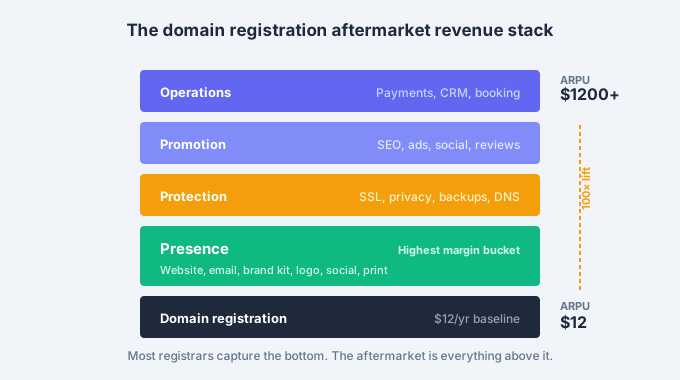
The domain registration aftermarket is everything a customer buys within the first three years of registering a domain, excluding the registration and renewal fees themselves. In practice it splits into four buckets.
- Presence. Website, email hosting, brand kit, logo, social profiles, print collateral. The most valuable bucket by revenue and by margin.
- Protection. SSL certificates, privacy, backups, DDoS mitigation, domain monitoring, DMARC and DNS management.
- Promotion. SEO tools, marketing automation, ad management, social scheduling, review management.
- Operations. Payments, invoicing, appointment booking, CRM, form processing.
Every one of these buckets contains vendors already making money selling to your customers. The question is not whether the domain registration aftermarket exists. It is whether the registrar captures it or lets someone else do it.

The 5 proven revenue moves in the domain registration aftermarket
Below are the five that have worked, in the order we recommend implementing them. None of them are exotic. They are all things registrars either already do badly, or do not do at all.
1. Attach a real site, not a parking page
The default post-registration experience for most domains is a parking page. It exists because DNS has to point somewhere, not because the customer wanted it. The customer bought the domain to build something, and the first thing they see is an ad for the registrar.
Replacing parking pages with a real, AI-generated starter site is the single highest-impact change in the domain registration aftermarket. The generation cost is small, the site converts a percentage of parked domains into recurring website subscribers, and the customer’s second visit to the domain is a working site rather than a placeholder. The math is straightforward. If 3% of parked domains convert to a paid site at $10 per month, and the registrar earns 50% of that, a portfolio of 100,000 parked domains is worth an extra $1.8 million per year in gross margin. Conservatively.
2. Bundle the brand kit at the moment of registration
The registration moment is the highest-intent moment the customer will ever have. They have just decided on a name, paid money, and are already thinking about the business the name represents. Every other touchpoint is downstream of this one.
That is exactly the moment to bundle a brand kit. A logo, matching colors, social profile images, a starter site, and an email address, all generated on the fly from the domain name. Not offered as a checkbox in the checkout, offered as the default post-registration flow. This is one of the highest-margin moves available in the domain registration aftermarket because the incremental cost per unit is near zero and the perceived value is high. A customer who came in to buy a $12 domain and left with a $79 brand kit is not annoyed. They are relieved.
3. Turn premium domain sales into full brand launches
Premium domains, aftermarket listings, and drop catches are already high-margin. What most registrars miss is that a customer buying a $2,000 aftermarket domain is signaling a serious business. They have budget. They have a plan. They are almost certainly going to spend another $10,000 to $50,000 on the launch over the next year.
Bundling a full-service brand launch package with premium domain purchases is a rare high-ticket play in the domain registration aftermarket. It is not for every registrar, but for the ones with a strong aftermarket portfolio it is a genuine growth lever. The bundle can include an AI-generated first pass, a human designer’s polish, hosting, email, and a launch marketing kit. Priced at $500 to $2,000 on top of the domain, it converts at surprising rates precisely because the customer has already anchored to a much larger number.
4. Rescue the renewal window with a real reason to stay
Renewals are a leaky bucket. Around 70% renew, the other 30% churn, and the industry has treated this as fixed. It is not fixed. The reason customers do not renew is almost always that the domain never became anything. They bought it, sat on it, and forgot about it.
The renewal window is the second-best moment for aftermarket capture, and most registrars use it for coupon promotions on the domain itself. That is a fine tactic to save a churner, and a terrible tactic to grow ARPU. A better play is to use the 60-day pre-renewal window to offer to build the site the customer never built. AI generation, one-line brief, live in ten minutes. Two things happen. Customers who see their domain finally become real are much more likely to renew. And a portion of them convert to a website subscription that runs alongside the renewal. Both metrics move.

5. Sell the exit gracefully
Every registrar has a long tail of customers who are going to leave. The domain no longer serves them, the business pivoted, the project died. The default flow is a cancellation form, a refund calculation, and a lost customer.
The last move in the domain registration aftermarket playbook is the one nobody talks about. Offer the exiting customer three options at the cancellation moment. Sell the domain into the aftermarket, park it with monetization split, or let it expire. Each option carries a different revenue share for the registrar. Even a small portion of exits monetized this way represents real money at portfolio scale, and it converts a bad customer experience into an amicable one. Customers who leave gracefully come back. Customers who cancel and get charged unexpected renewal fees do not.
Numbers that hold up in practice
The five moves compound. Here is what the math looks like at a typical mid-sized registrar with 500,000 domains under management.
- Baseline: $12 average annual registration fee, 70% renewal rate, roughly $4.2M in gross recurring domain revenue.
- With move 1 (attach): 3% of new registrations convert to a paid site averaging $10 per month, adding roughly $540K per year in recurring margin at 50% share.
- With move 2 (brand kit at registration): 8% attach rate on brand kits at $79 average, adding roughly $2.5M per year in one-time margin at 40% share.
- With move 4 (renewal-window attach): 2% of pre-renewal contacts convert to a site, adding roughly $420K per year and increasing the renewal rate by two percentage points.
- With move 5 (graceful exit): 5% of would-be cancellers monetize the domain, adding roughly $180K per year.
Total incremental revenue: roughly $3.6M per year on a $4.2M baseline. The domain registration aftermarket, sized properly and captured with modern tooling, is bigger than the primary market.
These numbers are illustrative but they are not aggressive. Every registrar we have worked with has landed somewhere in this range within the first year of implementing at least three of the five moves.
How to sequence the changes
The moves are not equal in implementation cost, and they are not equal in speed to revenue. Here is the sequence we recommend, roughly in order of ROI per month of engineering effort.
- Move 1 first. Replace parking pages with real starter sites. Lowest lift, highest visibility, immediate signal.
- Move 4 second. Instrument the renewal-window offer. Requires marketing automation but no new billing flows.
- Move 2 third. Integrate a brand kit generator into the checkout. Requires deeper integration but massive revenue upside.
- Move 5 fourth. Add the graceful exit flow. Small revenue but big NPS impact.
- Move 3 last. Premium domain launch bundles. Highest complexity, most curation, best margins per unit but slowest scale.
The order matters because each move creates the operational muscle for the next. Move 1 forces you to integrate a site builder into the DNS layer. Move 4 forces you to build attach mechanics into the billing platform. By the time you are doing Move 3, the plumbing is already there.
For registrars using WHMCS or Upmind as their billing platform, the WHMCS integration guide walks through the provisioning hooks that make Moves 1, 2, and 4 possible without custom development. For the strategic view specific to registrars, our registrar partner page covers the economics of each move in more detail.
Where to go next
Two things worth saying at the end.
First, the domain registration aftermarket is not going to stay uncaptured. Someone will build the tooling, the bundles, and the flows that turn a $12 registration into a $120 customer. If the registrar does not do it, the AI website builder companies will do it upstream, and the registrar becomes a commodity domain vendor.
Second, none of the five moves require exotic technology. They require a decision to treat the domain as the start of a customer relationship rather than the end of a transaction. That decision is the actual bottleneck.
We built BrandForge for exactly this handoff. It is a white-label AI brand and website platform designed to be integrated into a registrar’s checkout, renewal, and cancellation flows so that every one of the five moves above becomes an operational default rather than a special project.
- If you want the product-level view first, start with the website builder feature detail and the brand DNA generator.
- If you want the strategic conversation with our team, use the demo request page and we will walk through the numbers for your specific portfolio.
- If you are earlier in the process, the partner program overview is the right first read.
The domain registration aftermarket has been waiting for a decade. The economics finally line up. Now is a good moment to move.