The default assumption of the website builder industry has been the same for fifteen years. A small business website is a design project, and the customer is the designer. Wix, Squarespace, WordPress, and every reseller platform built on top of them all share that premise. Show the customer a blank canvas, provide templates and blocks, teach them how to arrange the pieces, and eventually a site gets published.
That premise is wrong. It has probably been wrong for the last five years. It is definitely wrong now. A small business website is not a design project. It is a piece of infrastructure the business needs to operate, and the customer wants nothing to do with the design. This piece is about why that shift has finally reached the tipping point in 2026, and what it means for hosting providers, registrars, and everyone else selling into the segment.
Table of Contents
What the blank canvas assumption got wrong
The blank canvas builder assumed the customer wanted creative control. That was true for early web-era users, who were often hobbyists, developers, or early adopters. It stopped being true somewhere around 2015, when the small business website customer became the small business owner rather than the tech enthusiast.
The small business owner does not want creative control. They want a working site so they can go back to running their business. The website builder industry has been selling them a design tool while they were asking for a done-for-you service. The gap has been visible in customer behavior for a decade: high abandonment rates, low completion rates, huge amounts of unfinished draft sites, and a persistent complaint that “I don’t have time to build this.” The industry read those signals as “customers need better templates” when they were actually saying “please just do this for me.”
What a small business website actually is
Before the five reasons, a definition worth being explicit about.
A small business website is a piece of business infrastructure that does three things. It tells prospects what the business does. It provides a way to contact or transact with the business. It signals to potential customers that the business is real and professional. That is essentially the entire functional requirement.
Nothing in that requirement demands creative expression, custom design, or particular aesthetic ambition. A small business website is closer to a phone number than to a portfolio. It is a utility, not a canvas. Once you accept that framing, the blank canvas approach starts to look like selling a woodworking shop to someone who just wanted a chair.

The 5 proven reasons the blank canvas is dead
Each of these has been true for years to some degree. What has changed in 2026 is that all five are now simultaneously acute, and the AI tooling exists to actually deliver the alternative.
1. Small business owners are not designers and never wanted to be
The average customer buying a small business website today is a plumber, dentist, coach, retailer, consultant, or contractor. Their job is running that business. They know their trade. They do not know what typography pairs well with a warm color palette, and they should not have to.
Every survey we have seen of small business builder customers puts “I don’t know what looks good” and “I don’t have time to design it” in the top three reasons sites do not get finished. The blank-canvas builder has been solving the wrong problem for this entire segment. The customer wants competence delegated, not tools provided. That is a category difference, not a feature difference, and no amount of drag-and-drop polish fixes it.
2. Completion rate on blank-canvas builders is unacceptable
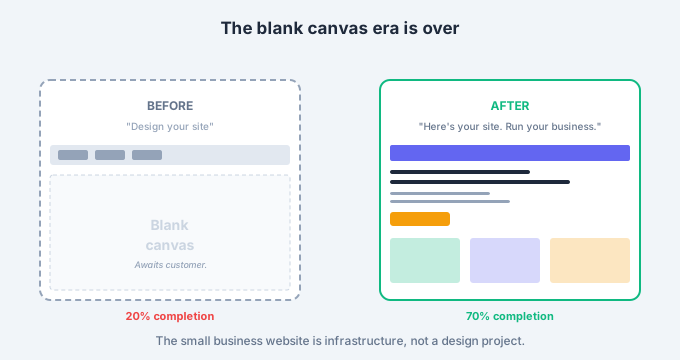
Blank-canvas builders convert somewhere between 15 and 25 percent of signups into published sites. For the reseller, that means the majority of what they sell never actually gets used. That is a terrible product-market fit signal that the industry has learned to tolerate because there was no alternative.
There is an alternative now. AI-generated small business website flows are converting 55 to 80 percent of signups into published sites. The completion-rate gap is the single most important operating metric in the segment, and it is what drives the reseller economics. Support costs, churn, LTV, word of mouth, all of them scale with completion rate. Once one reseller in a segment moves to an AI-first flow, the completion-rate gap becomes competitively fatal for everyone still on blank-canvas.
3. AI generation now matches human template quality
The obvious counter-argument to abandoning the blank canvas has been “the AI-generated output isn’t as good.” That was true until about eighteen months ago. It is no longer true for the mainstream small business website segments.
For a dentist, a coffee shop, a plumber, a coach, a fitness studio, a restaurant, a consultancy, or a retailer, a modern AI website builder produces output that is roughly equivalent to what a $500 freelance designer would produce, and in some cases better than what a mediocre template would produce. The gap between AI output and hand-designed output is now visible only at the high end of the market, where custom design was always going to win anyway. The mid-market has closed.
4. Time-to-live is a competitive metric
The blank canvas approach takes days or weeks to produce a live site, depending on how much time the customer can spare. The AI approach takes minutes. The competitive implication is that time-to-live has become a metric customers actually notice and choose on.
A small business owner comparing options is now regularly asking “how long does it take to have a live site.” The AI-first vendors have credible answers. The blank-canvas vendors have to explain that the answer depends on the customer’s design skills. That framing loses. Time-to-live has become the equivalent of page speed for consumer websites: something customers do not fully understand but definitely feel and choose on.

5. The value of the site is in operating it, not building it
The blank-canvas builder assumes the value of a small business website is created during the design phase. That is the wrong end of the funnel. A live, working site produces the value: leads, bookings, orders, and inquiries. The design phase is overhead.
Once you accept that framing, spending customer time on design is spending it in the wrong place. Every hour the customer spends adjusting the hero image is an hour they are not marketing the site, answering inquiries, or improving the business. The AI-first approach compresses design time to near zero and frees the customer to focus on the parts that actually create value. That is a much better allocation of the customer’s most scarce resource, which is their attention.
What replaces the blank canvas
The replacement is not another builder. It is a different kind of product entirely. The pattern that has emerged across successful AI-first small business website tools has three parts.
- A generated first draft that is 80 percent of a working site, produced within minutes of the customer describing the business.
- Directive editing that lets the customer change what they want in words, not by manipulating individual blocks.
- An automated operational layer for hosting, DNS, SSL, backups, and updates, so the customer never touches infrastructure.
The customer’s role becomes review, refinement, and go-live decisions rather than design and construction. This is a different product category, not a better version of the old category, and it is the one that is going to consume the small business website market over the next thirty-six months.
Who this hurts and who it helps
For clarity, the five reasons above have real losers and real winners.
Losers: template marketplaces, template-based reseller platforms, freelance web design at the low end, and any hosting product bundled with a legacy blank-canvas builder. All of these categories will shrink over the next two to three years as AI-first tools take their addressable market.
Winners: AI-first small business website platforms, resellers who switch to them early, businesses that use the freed-up customer attention for genuine operational improvements, and end customers who get a working site in an hour rather than a half-built site in a month.
There is a middle group that could go either way: mid-market design agencies, complex e-commerce platforms, and highly customized WordPress builds. These segments still have legitimate reasons for hand-crafted work, but they will need to defend that ground on quality rather than on the assumption that customers want to design. The customers do not want to design. They want to run their businesses.
For a related read on how this shift affects hosting economics specifically, see our post on AI replacing the web designer. For the strategic frame on why this is a new category rather than an incremental improvement, the AI brand builder new category piece covers the argument.
Externally, Statista’s data on small business website adoption shows the continued growth of small business online presence, which is the market the AI-first approach is uniquely positioned to serve.
Where to go next
The blank canvas assumption held for fifteen years because there was no realistic alternative. There is one now. Every hosting provider, registrar, and reseller platform selling website builder services to small businesses in 2026 needs to decide whether they are still selling a design tool or an operational service. The answer will define their next five years.
We built BrandForge as the operational service version, sold white-label through the reseller channel, precisely because the design tool era is ending and someone had to build the replacement for the reseller market.
- If you are evaluating for a hosting or registrar business, start with the hosting partner page.
- To see the product yourself, use the interactive demo.
- If you want the strategic conversation with our team, book time via the demo request page.
Blank canvas builders had a good run. The next fifteen years belong to a different assumption: the small business website is infrastructure, and the customer never wanted to be a designer.