The template website builder is not dead. It is just old. The category has been shipping essentially the same product since 2012, and the market is finally catching up to the fact that an AI website builder does something templates cannot. It produces a specific, on-brand, working first draft in the time it takes to describe the business.
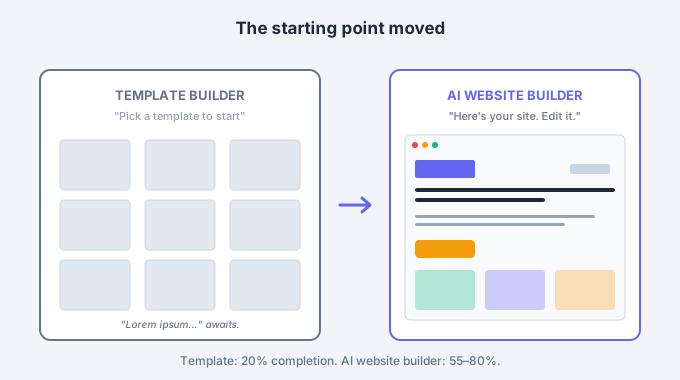
We watch this shift every week in partner accounts. A hosting provider swaps out its old template-based builder, drops in an AI website builder, and the completion rate on new signups goes from around 20% to somewhere between 55% and 75%. That is not a marketing number. That is the difference between a customer who buys a domain, tries to build a site, gives up, and cancels, versus a customer who buys a domain, sees a working site, and stays.
This piece explains why that happens. Seven reasons, in the order they show up in the customer journey, with the real mechanics behind each one.
Table of Contents
What actually changed between template builders and AI website builders
For a decade, “website builder” meant one thing. A gallery of templates, a drag-and-drop editor, and a set of blocks the user rearranged until something acceptable appeared. Every serious player, from Wix to Squarespace to WordPress page builders, competed on the same axes: template count, block count, integration count, template quality.
The change was slow, then fast. Large language models got good enough to write coherent marketing copy in mid-2023. Image generation got production-quality in 2024. Layout generation, the last piece, matured in 2025. By early 2026, a modern AI website builder can accept a domain name and a one-line brief and produce a site that is 80% of the way to launch-ready. That threshold is what breaks the template model.
The interesting part is that the AI website builder is not competing with templates on template quality. It is competing on a different metric entirely: whether the customer sees a working site before they lose interest. Templates lose that race almost every time.
The 7 proven reasons an AI website builder wins
Below are the seven observed differences that hold up across every partner deployment. They are not marketing bullets. They are the reasons the completion-rate number moves.
1. The starting point is a real site
A template builder starts with a blank page and a template gallery. The customer picks one, then confronts an editor full of placeholder text and stock images. An AI website builder starts with a fully populated site at the customer’s own domain, with their business name in the header, their tagline in the hero, and a first pass at their services on the page.
The psychological difference is enormous. In a template flow, the customer’s next task is “build the site.” In an AI website builder flow, the customer’s next task is “fix a few things about the site.” One of those tasks completes. The other does not.
2. Copy is written, not placeholder
Every template has “Lorem ipsum” or “Welcome to your new website” scattered across it. The customer has to replace every one of those strings. Writing marketing copy is hard. Most small business owners cannot do it in the amount of time they have available, so the placeholder stays, and the site never ships.
An AI website builder generates specific copy from the business description. The tagline names the business’s actual value. The services section describes the actual services. The customer’s task is to refine copy that mostly already works, which is a completely different cognitive load from writing copy from scratch. The refinement task completes at a much higher rate.
3. Images match the business, not the template
Templates ship with generic stock imagery. A dentist’s template has generic teeth. A restaurant template has generic pasta. A yoga studio template has generic stretching. The customer either lives with the stock imagery, which looks generic, or replaces every image, which requires either photography they do not have or paid stock they do not want to buy.
An AI website builder generates or selects images that match the specific business. The dentist’s site shows something closer to the actual practice. The restaurant’s site shows food in the actual cuisine style. Even when the images are still generated rather than photographed, they feel intentional rather than off-the-shelf. This alone accounts for a significant portion of the completion-rate gap.

4. The brand system is generated, not glued on
Templates give you a color palette and typography that came with the template. The customer either accepts it, in which case the site looks like every other site using that template, or changes it, which requires knowing what colors and fonts work together. Most customers do not know.
A modern AI website builder derives a brand system from the business description. Colors are chosen to fit the industry and the mood of the business. Typography pairs are chosen from a set that actually works. Logo, site, and social kit share the same system by default. The customer inherits a coherent brand rather than a blank one. When they edit, they edit within the system, which keeps everything visually consistent. That coherence is worth real money in a small business context.
5. Editing is directive, not manipulative
The template editor is a manipulation surface. Drag this block. Resize this image. Change this color. Every edit is a fine motor action, and the customer needs to know both what they want and how to achieve it with the editor’s specific controls. The learning curve is real.
An AI website builder makes editing directive. The customer says what they want in words, and the model changes the site. “Make the hero more energetic.” “Add a section for testimonials.” “Change the tone of the services page to be less formal.” The customer does not need to know where the controls are or what the block names are. The manipulation still exists as a fallback for power users, but the primary interaction is direction rather than manipulation. This shift alone doubles the number of edits an average customer will make before shipping.
6. Completion rate is the metric that matters
Template vendors have historically measured template quality, template count, block library size, and editor features. None of these metrics predict revenue for a reseller. The metric that predicts revenue is completion rate, meaning what fraction of customers who start a site publish one.
For template builders, completion rate typically runs between 15% and 25%. That figure lines up with industry conversion benchmarks published by the Baymard Institute for onboarding-style flows generally. For a modern AI website builder in the same market, completion rate runs between 55% and 80%. That difference is the entire business case. A reseller’s economics change fundamentally when three out of four signups become published sites rather than one out of five. Support costs drop. Churn drops. Word of mouth improves. LTV goes up. All of it flows from the same underlying shift in the completion metric.
7. Personalization scales with the model, not with headcount
Template builders scale personalization by hiring designers to create more templates. If you want a template for veterinarians, someone has to design it. If you want a template for veterinarians in Germany with a modern aesthetic, someone has to design that too. The library grows linearly with the design team.
An AI website builder personalizes by prompt, not by template. The same underlying system produces a site for a veterinarian in Germany or a food truck in Texas or a therapist in Milan. The model scales. The team does not have to. That is a completely different cost structure for the vendor, and it is why AI-first builders can afford to attack every niche simultaneously while template builders have to pick their battles.
The one thing templates still do better
For fairness, one place where templates still hold up. Complex, highly designed sites with strong specific aesthetics still benefit from a hand-crafted template as a starting point. Editorial sites, portfolio sites for designers, high-end restaurant sites with strong art direction. A really good template designed for that niche is still a better starting point than a generated one.
The point is that this segment is small. The vast majority of small business sites are informational, service-oriented, or transactional, and none of them require the aesthetic precision that makes a template a better starting point. For 90-plus percent of the reseller market, an AI website builder is a better fit. The remaining segment will still buy template-based tools, and that is fine.

How to evaluate an AI website builder against a template stack
If you are running an evaluation right now, four tests separate the real from the marketing.
- Give it a specific business. Not “coffee shop.” Give it “third-wave coffee shop in Rotterdam specializing in Ethiopian single-origin beans, seating for twelve.” A serious AI website builder produces a site that reflects those specifics. A weak one produces a generic coffee shop template with different colors.
- Read the copy. If the generated copy has to be entirely rewritten to be usable, the model is not good enough. If the customer only has to tweak, the model is ready.
- Look at the images. Are they specific to the business or clearly stock? Do they visually cohere with the copy and the color palette?
- Edit by directive. Ask it to change the tone, add a section, or swap the layout. Does it do the thing you asked, or does it produce something else? Directive editing is the future of the category, and if a vendor’s editor cannot handle it, they are behind.
None of these tests are hard, and none of them can be faked in a scripted demo. Any AI website builder that clears all four is worth serious evaluation.
For hosting providers and registrars looking at the market seriously, our comparison against traditional builders covers the technical differences in detail. For the reseller economics of switching, our partner overview has the pricing model discussion.
Where to go next
The category shift is roughly halfway through. In 2024, most resellers were still shipping template-based builders and treating AI features as an add-on. In 2026, the leaders have flipped the polarity. AI generation is the primary flow, templates are a fallback for power users, and the completion-rate metric has moved by a factor of three.
If you are a hosting provider, registrar, telco, or agency reselling a template builder today, the switch is neither optional nor difficult. What matters is timing. The partners that switched in 2025 are already seeing the LTV improvement. The ones that switch in 2027 will be catching up to a market that has already re-anchored on AI-first expectations.
We built BrandForge as an AI website builder for exactly this transition, sold white-label through the reseller channel rather than direct to consumer.
- To see the product in action, use the interactive demo or book a walkthrough via the demo request page.
- If you are evaluating for a hosting business, the hosting partner page covers the specific integration and economics.
- If you want the broader thesis, our post on the AI brand builder as a new category is the right long-form read.
The template era was a good one. The next era is going to be more useful to more people, and the AI website builder is what makes that possible.