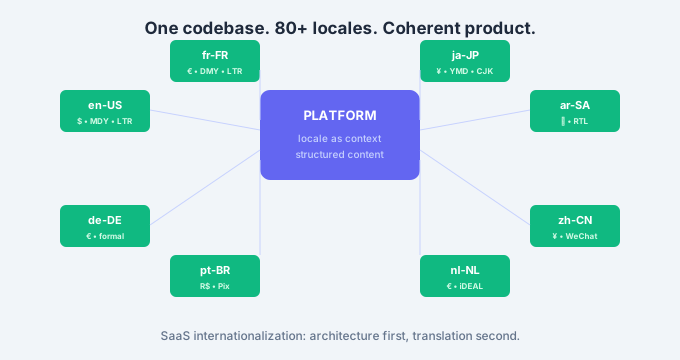
SaaS internationalization at eighty-plus locales is not a translation task. It is a systems architecture problem that touches copy, currency, timezones, addresses, number formats, right-to-left layouts, plural rules, gender, formality registers, and the AI generation layer. Teams that treat SaaS internationalization as “wrap the strings in a translation function” end up with a product that works in English and slowly degrades everywhere else.
We built BrandForge to work across a large locale set from day one, because the reseller channel is global and a white-label product that only works in English is not really a global product. This piece is the seven patterns that consistently produce working SaaS internationalization at scale, based on what has and has not worked in our own architecture and in partner deployments.
Table of Contents
Why SaaS internationalization gets underestimated
SaaS internationalization looks small when you start. English works, so localization is “just” hiring translators. Currency is “just” a display change. Layouts are “just” a CSS switch. Every one of those “just” statements is wrong in specific ways, and the cost of the wrongness compounds as the locale count grows.
The reason it looks small is that most engineers first meet SaaS internationalization when the product is already mature. The architecture assumptions of the mature product bake in English defaults, timezone assumptions, layout assumptions, and content-model assumptions that all have to be unwound to genuinely internationalize. The unwinding is the expensive part, not the translation. Teams that build SaaS internationalization in from the start avoid ninety percent of the retrofit cost, which is why the seven patterns below matter most at the architecture stage.
What SaaS internationalization actually has to cover
Before the seven patterns, a full inventory of what varies across locales, because most inventories are incomplete.
- Language and script. Latin, Cyrillic, Arabic, Chinese, Japanese, Korean, Devanagari, Thai. Each has its own typographic requirements.
- Direction. Left-to-right and right-to-left, and mixed content within a single string.
- Currency. Symbol placement, thousands separator, decimal separator, negative-value formatting.
- Numbers and dates. Decimal formats, calendar systems, date order (DMY, MDY, YMD), 12/24 hour clock.
- Addresses. Street-first, city-first, postal code position, region names.
- Pluralization rules. Some locales have two forms, some have six.
- Gender and formality. Grammatical gender agreement, T/V distinction, honorifics.
- Legal and regulatory. Data residency, cookie disclosure, VAT collection, invoicing requirements.
- Payment methods. Card, iDEAL, SEPA, Boleto, Pix, WeChat Pay, and dozens of others regional to specific markets.
Every one of these is a real production concern in a serious SaaS internationalization effort. Missing any one produces the kind of subtle wrongness that erodes trust in specific markets.

The 7 proven SaaS internationalization patterns
1. Locale as a first-class request context
Every request in the system has a locale, and the locale is available to every layer that renders anything visible to the user. Not as a URL parameter that some code paths honor and others ignore, but as a first-class piece of request context that flows through routing, controllers, services, templates, and generation calls.
This pattern is the foundation. If locale is a first-class context, every downstream pattern gets easier. If locale is a bolt-on that some code paths know about and others do not, every downstream pattern becomes an exception hunt. Almost all SaaS internationalization failures we investigate trace back to this pattern being weak or inconsistent.
2. Copy stored as structured content, not strings
The naive approach to SaaS internationalization stores translations as key-value string pairs. Homepage title in English maps to homepage title in French. This works for static UI strings and breaks for everything else. Marketing copy, template content, AI-generated content, and dynamic strings all have structure that string maps cannot preserve.
The pattern is structured content. Copy is stored as content objects with attributes (headline, body, call-to-action, tone) and localized variants for each locale. Content objects can carry rules, defaults, and fallbacks. When a locale is missing a specific field, the fallback is explicit rather than random. Structured content lets the SaaS internationalization stack handle rich content, not just interface labels, which is what a modern product actually needs.
3. Native AI generation per locale, not translation after the fact
If the product generates content (site copy, brand voice, marketing text, product descriptions), that generation has to happen in the target locale natively, not by generating in English and translating afterward. Translation-after-the-fact preserves grammar but loses register, idiom, and cultural resonance. Native generation captures all three.
This is one of the biggest recent shifts in SaaS internationalization. Frontier models are now good enough to generate high-quality content in dozens of languages directly, which was not true even three years ago. Products that still translate from English are shipping degraded content in every non-English market. Products that generate natively per locale sound native. The gap is visible to any local speaker within a paragraph.
4. Currency, tax, and payment locality at the platform layer
Currency, tax, and payment handling has to live at the platform layer, not at the product layer. That means the billing platform knows which currency to display, which tax to apply, which payment methods to offer, and which invoicing rules to follow, and the product code just passes locale context down.
The failure mode without this pattern is per-market special cases scattered through the codebase. Some markets get invoicing right, others get it wrong, and every new market requires a hunt through the code to find the special cases that need updating. The pattern is centralization at the platform layer, which turns adding a new market into a configuration change rather than a code change. Serious SaaS internationalization efforts run through this centralization discipline.
5. RTL and CJK layouts as design tokens, not overrides
Right-to-left languages (Arabic, Hebrew, Persian) and CJK languages (Chinese, Japanese, Korean) both require layout considerations that are more than string translation. RTL flips the visual reading direction. CJK typography needs different line-height, character spacing, and font stacks. Handling these as CSS overrides for specific locales is fragile.
The pattern is to expose direction and script as design tokens that the whole design system understands. Components read the tokens and render accordingly, rather than requiring per-locale CSS files. This is more work up front and much less work per new locale added. SaaS internationalization that treats RTL as a plug-in ends up rewriting components as new markets appear. SaaS internationalization that treats direction and script as first-class tokens scales.

6. Formality and register signaled per locale
Different locales expect different formality defaults. German business communication is more formal than American English. Japanese has multiple explicit formality levels. Brazilian Portuguese is generally warmer than European Portuguese. The AI generation and copy layers have to know the locale’s expected register, not just its language.
The pattern is to attach a formality and register signal to every locale, and to pass that signal to any generation or content selection step. This is a small piece of metadata that meaningfully improves the perceived quality of the product in every market. Products that get formality right feel local. Products that use the same warm American tone in every market feel like they were made somewhere else.
7. Locale-aware testing at every commit
The one operational pattern that ties the others together. If SaaS internationalization only gets tested manually before a release, regressions creep in constantly and the team stops trusting the localization. If it gets tested automatically at every commit, regressions get caught before they ship and confidence stays high.
Locale-aware testing includes visual regression across the top ten locales, string extraction and coverage checks, currency and date format validation, and RTL layout snapshots. This is not glamorous work, but it is the only way to keep SaaS internationalization from silently degrading over the ninety-day cycles of normal feature work.
What breaks first when SaaS internationalization is retrofitted
Retrofitting SaaS internationalization onto a mature codebase is the most common path, and it fails in predictable places.
- Hardcoded strings in templates. Every one has to be found and extracted, and there are always more than expected.
- English defaults in date and number formatting. JavaScript’s default date formatting is not locale-aware unless you make it be.
- Layout assumptions in CSS. Fixed widths, hardcoded padding, and text-alignment that assume left-to-right all break in RTL.
- Payment code that assumes USD. Currency handling turns out to be sprinkled through the codebase, not centralized.
The retrofit path takes twelve to eighteen months for a mature SaaS product. Building it in from the start takes maybe three months of extra architecture work. That ratio is the reason experienced teams push for SaaS internationalization at the platform design stage.
How to sequence the work if you are starting now
If your product is early and you want to build SaaS internationalization in properly, sequence roughly like this.
- Pattern 1 first. Locale as first-class context in the framework.
- Pattern 4 next. Currency, tax, and payment at the platform layer, before you have too many customers to migrate.
- Pattern 2 third. Structured content model, so copy is not scattered as strings.
- Pattern 5 fourth. Design tokens for direction and script, before you have components to rewrite.
- Pattern 7 fifth. Locale-aware testing as part of the CI pipeline.
- Patterns 3 and 6 last. AI generation per locale and formality registers, once the platform is stable enough to support them.
The ordering matters because each pattern makes the next one easier. Rushing pattern 3 without pattern 1 in place produces high-quality generated content that lives in a system that cannot flow it properly. Building the foundation first pays back through every subsequent expansion.
For the reseller-channel view of SaaS internationalization specifically, the partners overview covers how our locale support flows to partner deployments. For the technical detail on how our platform handles some of these patterns, the features overview has the product view. For a related read on why platform-level localization matters more than plugin localization, see our post on the branded AI website builder launch.
Externally, the Unicode Consortium’s CLDR project is the canonical reference for locale data and is the source almost every serious SaaS internationalization effort relies on for the raw locale definitions.
What the retrofit path actually costs
For teams facing the retrofit rather than the greenfield choice, the honest cost picture matters. Nobody plans to retrofit. Retrofits happen because the product succeeded in an English market and the team eventually decides to go global.
The retrofit costs are usually underestimated by a factor of two or three because much of the work is invisible until you start doing it. String extraction from templates is straightforward. Detecting hardcoded English in error messages, log formatting, admin panels, and helper utilities is not. Every retrofit project we have seen has a moment around month four when the team realizes the scope is larger than the initial estimate, and the response either doubles the team or descopes the ambition.
The parts that most consistently surprise retrofit projects are date and number formatting, because JavaScript defaults are not locale-aware and the pattern of using them without wrappers is deeply established in most codebases. Currency handling is second, because payment code touches almost every layer of the product. RTL layouts are third, because they require rethinking spacing, alignment, and visual hierarchy at the component level.
The parts that are easier than expected are copy translation for UI strings, because once the extraction is done the actual translation is a straightforward vendor engagement, and locale routing at the request layer, because it is well-solved by mature frameworks.
Budgeting a retrofit realistically means planning for the four hard areas and being efficient in the two easier ones. Teams that budget the easy work and hope the hard work will be similarly easy consistently run over.
What good teams do differently on greenfield
For teams building a new product with global ambitions from day one, three practices consistently separate the projects that ship international-ready from the ones that ship English-only with plans to internationalize later.
The first is treating locale as a mandatory parameter, not an optional one. Every function that renders anything visible to a user takes a locale argument, and the framework enforces it at compile time or lint time. This one discipline prevents the accumulation of code that assumes English by omission, which is the seed of every retrofit nightmare.
The second is defining the initial locale set at the design stage rather than at the launch stage. If the product will eventually serve twenty locales, choose three representative ones on day one and build for those. English plus one RTL language plus one CJK language exposes almost every architecture issue that would otherwise appear only during expansion. Building for those three from the start is dramatically cheaper than building for one and expanding later.
The third is running the international-ready CI from the first commit. Even a simple check that no new strings are hardcoded is a powerful forcing function. Teams that discipline themselves early ship international-ready products without the retrofit cost. Teams that plan to add the discipline later never quite get around to it, and the retrofit bill arrives eventually.
Common questions from teams starting a SaaS internationalization project
Two questions come up in every kickoff meeting for a SaaS internationalization project, and answering them clearly saves the team from expensive early mistakes.
The first is how many locales to start with. The honest answer is three, chosen to be diverse. English plus one right-to-left language plus one CJK language exposes almost every architectural issue that would otherwise appear only at expansion time. Starting with English plus French plus Spanish feels safer but delays the discovery of the hardest problems. SaaS internationalization done right addresses the hard cases from day one, and the easy cases come along for free.
The second is whether to use a translation management platform or manage locales in the codebase. The answer is a translation management platform, always, for anything beyond a very small locale set. The tooling handles workflow, versioning, and translator collaboration in ways that home-grown solutions never quite match. SaaS internationalization is a specialized discipline, and the tooling that supports it has matured to the point where reinventing it is not a good use of engineering time.
Where to go next
SaaS internationalization at scale is a specific engineering discipline that pays back over the long life of the product. Done right, it lets a single codebase serve eighty locales without accumulating market-specific technical debt. Done wrong, every new market becomes a project.
We built BrandForge with the seven patterns as the architecture center because we knew the reseller channel would require broad locale support from year one.
- If you are a partner evaluating BrandForge for a multi-locale market, start with the partners overview.
- For the product-level view of how localization flows, the features overview has the platform detail.
- For a technical conversation with our team on your specific locale requirements, book time via the demo request page.
SaaS internationalization is not a translation project. It is a systems architecture decision. Make it early and make it right.