A multi-registrar platform gateway is one of those pieces of infrastructure that nobody notices when it works and everybody notices when it does not. Registrars, hosting providers, and any SaaS product that sells domains as an attach face the same architectural question: how do you talk to five, ten, or thirty different registrar backends without your business logic drowning in per-registrar special cases.
We build and operate a multi-registrar platform gateway inside BrandForge because we sell domains through the reseller channel and every channel partner has different registrar preferences. After watching what does and does not scale, five patterns account for almost every well-designed gateway we have seen. This piece walks through each one with enough technical detail to guide implementation decisions.
Table of Contents
Why a multi-registrar platform gateway exists at all
You build a multi-registrar platform gateway for one of three reasons. First, resilience: if a single registrar has an incident, your product should keep working. Second, coverage: no single registrar has strong pricing on every TLD, so multi-registrar lets you route each customer’s domain to the best-priced option. Third, commercial flexibility: different partners want to use different registrars, and a gateway lets you serve them all without maintaining separate code paths.
None of these three reasons matter if your volume is low or your TLD coverage is narrow. A boutique product selling a hundred .com domains a month can happily talk directly to a single registrar. The multi-registrar platform gateway becomes essential at higher volume, broader coverage, or with reseller channel partners who each have their own registrar preferences. If none of those apply, do not build a gateway. If all three apply, you need one.
What the gateway has to abstract over
Before the five patterns, a quick inventory of what varies across registrars, because the variation is the entire reason the abstraction is hard.
- Protocol. Some registrars expose EPP, some expose custom REST APIs, some expose SOAP, some expose a WHMCS-style module contract. All of these speak roughly the same domain lifecycle but in incompatible dialects.
- Authentication. API keys, mutual TLS, certificate-based auth, OAuth, and IP whitelist all appear across the registrar landscape.
- TLD coverage. Every registrar supports a different subset of TLDs at different price points and with different capabilities (privacy, DNSSEC, glue records).
- Rate limits. Registrars vary from generous to extremely tight rate limits, and hitting them fails silently in some cases.
- Idempotency behavior. Some registrars deduplicate identical requests correctly. Others do not. Never assume.
- Error semantics. Same conceptual error appears as different codes across registrars, and the mapping is not obvious.
A multi-registrar platform gateway that ignores any of these differences will produce production incidents. Handling them all is what the five patterns below are for.

The 5 proven multi-registrar platform patterns
1. Canonical operation model, not per-registrar SDKs
The wrong way to build a multi-registrar platform is to import every registrar’s SDK and let application code call whichever one applies. That approach couples business logic to registrar-specific interfaces and turns every downstream change (new registrar, sunsetted registrar, API version bump) into a full-stack change.
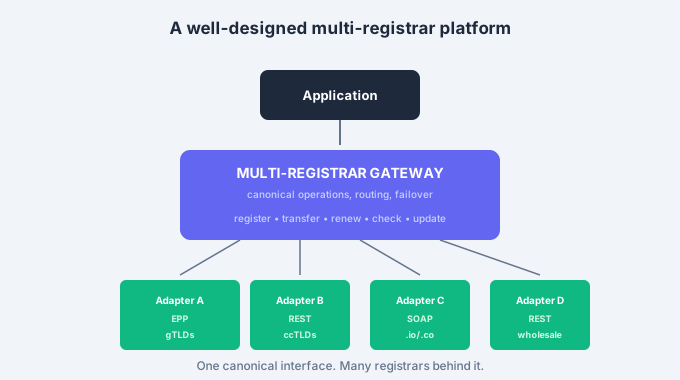
The right pattern is a canonical operation model. The gateway exposes a stable, minimal set of operations (register domain, transfer domain, renew domain, update contacts, check availability, etc) with a well-defined schema. Every registrar has an adapter that translates the canonical operation into the registrar’s specific protocol. Application code only ever knows the canonical operation model. This decoupling is the single most valuable design decision in a multi-registrar platform.
2. Async job pipeline with idempotency keys
Registrar operations are slow, sometimes very slow. Domain registration can take seconds under normal load and minutes when a registry is having a bad day. Doing this work synchronously in the request path is a bad idea. The pattern is to queue every operation as a job, execute it asynchronously against the appropriate registrar, and expose status via polling or webhook.
Every job carries an idempotency key. If the same operation is submitted twice (network retry, client duplicate, user impatience), the gateway detects the duplicate and returns the existing job’s status rather than double-executing. This one pattern eliminates the entire class of “the domain got registered twice” incidents that plague naive multi-registrar platform implementations.
3. Registrar routing by capability, price, and health
Not every operation should go to every registrar. Some TLDs are only offered by specific registrars. Some registrars have better wholesale pricing on specific TLDs. Some registrars are currently having incidents. The gateway needs a routing policy that decides which registrar handles which operation.
The pattern that works is a scored routing policy. For each incoming operation, the gateway scores each candidate registrar on three axes: capability (can this registrar do this operation on this TLD), price (what does it cost right now), and health (is this registrar currently healthy). The highest-scoring registrar wins. The routing policy can be updated without touching application code, which lets ops teams shift traffic during incidents or price changes without a deploy. A serious multi-registrar platform lives or dies on the quality of this routing.
4. Per-registrar quirk isolation
Every registrar has quirks. One registrar returns success on a duplicate registration but does not actually register the domain the second time. Another registrar’s rate limit is not documented and only shows up as an obscure 429 response. Another expects contact data in a specific normalization that is not in the spec.
The pattern is to isolate every quirk in the adapter for that specific registrar. Application code, and even the canonical operation model, remain clean. When a new quirk is discovered, it gets patched in the adapter with a comment explaining the situation, and the rest of the gateway stays unaware. Multi-registrar platforms that let quirks leak upward into the canonical layer accumulate technical debt fast, because every application-level developer eventually starts working around registrar-specific behaviors they should not have to know about.
5. Failover with commit semantics
The scenario the multi-registrar platform gateway has to handle correctly: an operation is submitted, the primary registrar accepts it and starts processing, then the registrar has an incident before confirming. Was the domain registered or not? Should the gateway retry against a fallback registrar, or wait?
The pattern is explicit commit semantics per operation. Every operation is either idempotent (safe to retry) or committing (must not be retried blind). Registration is committing: once the registry has issued the domain, retrying against a different registrar creates a conflict. Availability check is idempotent: retrying is fine. The gateway tracks the commit status of every job and only fails over on operations where failover is safe. Operations in a committed-but-unconfirmed state hold until reconciliation with the registrar’s status API. This pattern is what separates a gateway that survives real incidents from one that creates them.

Common architectural mistakes
Four mistakes we see teams make when they build a multi-registrar platform from scratch.
- Synchronous execution in the request path. Turns every registrar hiccup into a customer-facing timeout.
- Application code that knows which registrar it is talking to. Kills the whole point of the gateway.
- Blind retry across registrars. Creates duplicate registrations, which is expensive and hard to reverse.
- No health signal or manual failover only. Turns every registrar incident into a full-team fire drill.
Each mistake is common enough that we mention it explicitly. Together they are the reason many first-generation multi-registrar platform projects need to be rewritten before they scale.
When to build versus buy
The build-versus-buy decision on a multi-registrar platform gateway depends on volume and strategic differentiation. A rough guide.
- Under 10,000 domains per month and a narrow TLD range: use a single registrar. The gateway is overhead you do not need.
- 10,000 to 100,000 domains per month across five to ten TLDs: buy a gateway from a specialized vendor or use a billing platform that includes routing.
- Over 100,000 domains per month with strong opinions about routing, pricing, or reseller flexibility: build. At that scale, the gateway is a strategic asset and the abstraction serves your business logic best when you own it.
Between those tiers there is real judgment. The technical patterns are the same either way; the decision is whether the multi-registrar platform is a core competency for your business or a commodity dependency.
For the reseller economics side of the multi-registrar platform question, the registrar partner page covers how routing decisions affect margin. For the broader platform view, the platform integrations overview covers what we integrate into. For a related read on why the aftermarket matters more than the primary registration itself, see our post on the domain registration aftermarket.
Externally, ICANN’s EPP protocol documentation is the canonical reference for the underlying protocol most registrars speak, and reading it is essential before writing any adapter code.
What operating a multi-registrar platform gateway actually looks like
Beyond the architecture patterns, the operational side of running a multi-registrar platform gateway has its own rhythms and disciplines. Teams that build the gateway without planning for its operational life discover that architecture is only half the work.
The daily reality of running a gateway includes registrar API changes, rate limit adjustments, unannounced maintenance windows, and the occasional wholesale price update that has to propagate through the routing policy. None of these are exotic events, and none of them break anything if the gateway architecture handles them, but each requires a specific operational response.
Weekly reviews at a mature gateway operation cover routing policy tuning, adapter health metrics, error rate trends by registrar, and cost per successful operation. The last of these is the metric that closes the loop between the gateway and the business. If cost per successful registration is drifting upward, either a registrar has raised prices or the routing policy is sending traffic to more expensive lanes than needed. Both are correctable with configuration.
Monthly reviews usually cover capacity planning for new TLDs, evaluation of new registrar partnerships, and decommissioning of underperforming adapters. The gateway is a living portfolio, not a static piece of infrastructure, and the ongoing curation is what keeps it aligned with the business.
The teams that run gateways well treat this operational work as a first-class discipline, staffed and reviewed with the same seriousness as any other production infrastructure. The teams that treat it as an afterthought discover that the gateway they built two years ago has quietly drifted into an unmaintainable state, and the cost of catching up is much higher than the cost of steady maintenance would have been.
When the multi-registrar platform decision comes up again
For a multi-registrar platform gateway that has been running for two or three years, the strategic question tends to resurface. Should we keep expanding registrar coverage, consolidate down to a shorter list of preferred partners, or restructure the routing policy around new priorities.
The answer usually depends on what the business is trying to achieve at that moment. A gateway optimized for resilience will keep more registrars in the mix than one optimized for margin. A gateway optimized for TLD coverage will look different from one optimized for peak-load handling. The strategic question is really about which of these objectives the business is prioritizing, and the gateway configuration follows from that decision.
The mistake to avoid is treating the multi-registrar platform as a set-and-forget system. It is a strategic asset that rewards active management, and the periodic revisit is what keeps it aligned with the business rather than gradually drifting into technical debt.
Common questions from teams evaluating a multi-registrar platform
Two questions come up in almost every technical conversation about building or buying a gateway, and they deserve direct answers.
The first is whether the gateway should be synchronous or asynchronous end-to-end. The honest answer is asynchronous, always. Registrar operations are inherently slow and unpredictable, and any gateway that tries to keep them synchronous ends up passing that unpredictability directly to the calling application. Async plumbing is more work up front and dramatically less operational pain in production.
The second is whether the gateway should expose registrar-specific features or stick strictly to the canonical operation model. The answer is that the canonical model should cover 95 percent of use cases, and registrar-specific features should be handled through explicit escape hatches rather than by bleeding into the canonical layer. A gateway that lets registrar-specific concepts leak upward loses the abstraction benefit that motivated building the gateway in the first place.
Architecture decisions made cleanly at the start save years of maintenance cost. Decisions deferred until scale forces them cost more than the original build would have.
What operators wish they had known earlier
Beyond the two most common questions, there is a longer list of things operators of gateways say they wish they had understood before starting the work. A few recurring themes are worth sharing.
The value of good observability is consistently underestimated at the design stage. Teams build the gateway, get it working, and only start instrumenting it deeply once something goes wrong. By that point the missing instrumentation costs weeks of investigation for incidents that structured logging and per-adapter metrics would have resolved in hours. Build the observability into the architecture, not on top of it.
The importance of the routing policy as configuration rather than code is another retrospective realization. Teams that hard-code the routing decisions find themselves needing a deploy every time a registrar has an incident or a wholesale price shifts. Teams that express the routing as data-driven policy can adjust in minutes without touching the codebase. The difference in operational agility is significant.
The cost of maintaining test coverage across adapters is higher than expected. Every adapter needs its own contract tests against the actual registrar backend, and those tests need to run regularly enough to catch upstream API changes. Teams that treat testing as a one-time investment discover the coverage rot within a few months. Teams that treat it as ongoing infrastructure keep the gateway healthy.
These realizations are cheap when they arrive at design time and expensive when they arrive in production. Sharing them is the point of writing this down.
Where to go next
A multi-registrar platform gateway is the kind of infrastructure that pays back over years, not weeks. Get the five patterns above right at the start and the gateway ages gracefully as registrars come and go. Get them wrong and you rebuild it in eighteen months.
We built our multi-registrar platform gateway to serve reseller partners who each have their own registrar preferences, because that is what our channel needs. The patterns above are what we settled on after two years of iteration.
- If you are a registrar or reseller evaluating BrandForge, start with the registrar partner page.
- For the broader partner picture, the partners overview covers the segments we serve.
- For a technical conversation about integration, book time via the demo request page.
A multi-registrar platform is invisible when it works. That is the whole point.