The most important of the current website builder trends is not a feature. It is a split. For fifteen years the website builder market was a single category with different flavors. Wix was different from Squarespace was different from WordPress, but all three were competing for the same customer with roughly the same product shape. That coherent market is coming apart in 2026, and understanding the split matters for anyone building, reselling, or investing in the space.
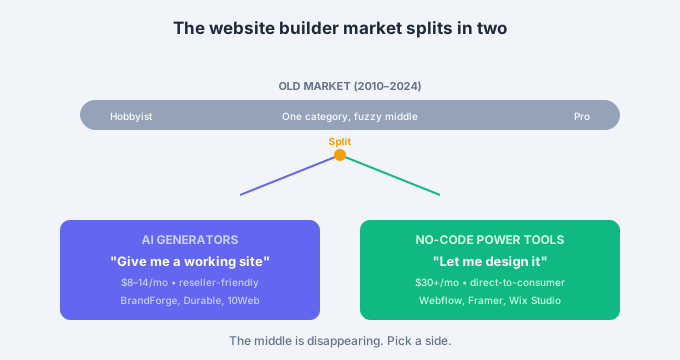
The split runs down the middle of the old category. On one side are no-code power tools aimed at people who genuinely want to design. On the other side are AI generators aimed at people who genuinely do not. The customers, the pricing models, the reseller channels, and the underlying technology are diverging fast, and by the end of 2026 they will look like two different markets even though they share a name today. This piece walks through the five clearest signals of the split.
Table of Contents
What the website builder market used to be
The old website builder market was a single continuum. On one end sat professional-grade tools like WordPress and Webflow, aimed at developers, designers, and agencies. On the other end sat drag-and-drop consumer tools like Wix and Weebly, aimed at hobbyists and small business owners. In between sat everything else. The whole spectrum was called “website builders,” and vendors mostly competed on how good they were within their slot on the continuum.
That single-market model worked because the underlying assumption held: everyone building a site was doing some form of design work, and the differences between vendors were about how much design skill the tool required. The AI generation shift breaks that assumption. Half the market now does not want to do design work at all. The other half wants more design control than any consumer tool ever offered. There is no coherent middle anymore, and the current website builder trends confirm the middle is being abandoned.
How the split is showing up in the data
Public data on website builder trends is patchy, but the pattern is visible in several places at once. New signup mix at consumer-facing brands is skewing away from template-only flows. Reseller platforms are reporting rising demand for AI-first products and declining renewal on template-based ones. Investment activity in 2025 was heavily concentrated on either high-end no-code tools (Framer, Webflow-adjacent) or AI generation startups, with almost nothing landing in the middle.
The clearest single indicator is user session time. On template-based tools, average time-to-first-publish has been climbing for three years. On AI generators, it has collapsed to minutes. Users are self-sorting into the two experiences that actually fit what they want, and vendors are following the traffic.

The 5 proven website builder trends that signal the split
Each of these has moved noticeably in the last twelve months and is now clear enough to plan around.
1. Pricing is diverging across the two sides
The old website builder market had roughly overlapping price points. Wix, Squarespace, and Weebly all priced entry-level plans in the $12 to $18 per month range. That was the anchor for the whole category. In 2026 that anchor is gone.
On the no-code power tool side, Framer and Webflow entry plans have moved decisively above $30 per month and pro plans well above $60. The customer is a designer or a small team, and the tools now price accordingly. On the AI side, generation-first tools are pricing between $8 and $14 per month for the AI-inclusive experience, sometimes lower on the reseller channel. The gap in retail pricing between the two sides is now larger than the entire old price range of the unified market. That divergence is one of the clearest website builder trends and it will keep widening.
2. Customer segments are separating cleanly
The old market had a fuzzy middle. Small business owners with some design interest bought Wix. Freelance designers on a budget bought Squarespace. Agencies with fewer resources bought Weebly. Everyone was solving roughly the same problem with roughly the same tools.
That fuzziness is resolving. Small business owners with no design interest are moving to AI generators. Designers, freelancers, and agencies are moving to no-code power tools. The old middle segment (mildly design-interested consumers who wanted control but not too much) has largely evaporated because the AI side now gives them a working site without requiring interest, and the no-code side offers real power for those who want it. The two segments no longer meaningfully compete for the same customer, which is one of the strongest website builder trends of the past year.
3. Reseller economics only work on one side
Reseller channels (hosting providers, registrars, telcos, MSPs) can only support one of the two sides at scale. The no-code power tool side requires per-customer support cost that only works at higher price points, which the reseller channel cannot deliver on a mass base. The AI generator side has support economics that work at hosting prices, which the reseller channel can absorb.
This has become one of the most consequential website builder trends for the reseller ecosystem specifically. Any hosting provider trying to resell a no-code power tool at commodity hosting prices is going to lose money on support. Any reseller pushing an AI generator can price it appropriately for their base and see it move at volume. The choice is not about product preference. It is about which economics match the channel.
4. Feature investment is moving in opposite directions
Feature roadmaps at the two ends of the split are diverging in the same direction as the customers. No-code power tools are investing in CMS depth, component libraries, animation systems, integration ecosystems, and developer-adjacent capabilities like custom code injection. Their customers are power users, and the roadmap reflects that.
AI generators are investing in prompt quality, brand DNA sophistication, multi-artifact coherence, and reduction of the number of steps between customer intent and finished output. Their customers are people who want to be done, and the roadmap reflects that. Vendors that try to invest in both directions dilute their identity and end up serving neither side well. The website builder trends here are about clarity of positioning, and vendors that pick a side are winning.

5. Time-to-live has become a positioning axis
Old website builder marketing centered on template quality, feature depth, and total feature count. New marketing centers on how fast a customer gets to a working site. On the AI side, “live in ten minutes” is the pitch. On the no-code side, “as fast as your design skills allow” is the implicit promise.
Neither side treats time-to-live the way the old market did, which was largely ignored. The market has learned that time-to-live is the customer signal that actually predicts completion rate, and vendors are positioning on it explicitly. This shows up in landing pages, sales collateral, and product demos. It is one of the current website builder trends most visible to anyone paying attention to the category messaging.
Which side each major player is landing on
Rough current positioning as of mid-2026, based on public roadmaps and observed customer mix.
- AI generation side. BrandForge, Durable, 10Web, Framer AI (partial), various emerging startups. Focus: generation-first, coherent brand kit, reseller-friendly.
- No-code power tool side. Webflow, Framer (core product), Wix Studio (partial), Squarespace Studio (partial). Focus: design control, CMS, integrations, professional workflows.
- Trying to straddle. Wix, Squarespace, WordPress ecosystem. Focus: both, which increasingly reads as neither.
The vendors trying to straddle the split are the most interesting to watch. They have the largest customer bases and the strongest brand recognition, but they also carry the most baggage from the old model. Whether they successfully split their product lines or hold their existing single-product approach will define much of the next two years of website builder trends.
What the split means for hosting and registrar channels
For the reseller ecosystem, the split has practical implications. Choose the AI generation side almost by default, because it is the side where reseller economics work. Do not try to bundle a no-code power tool into a shared hosting plan; the price points do not align and support cost will eat the margin.
For customer education, help small business customers understand that “website builder” now means two very different things. The customer who wants a working site should be pointed to an AI generator. The customer who wants to design should be pointed to a no-code power tool, usually direct-to-consumer rather than through the hosting channel. Trying to serve both from the same reseller storefront produces churn and support cost.
For product bundling, an AI website builder pairs naturally with domain, email, and hosting. A no-code power tool pairs naturally with premium DNS, CDN, custom hosting, and developer tooling. Mixing the pairings produces confused customer journeys.
For a deeper view of the reseller economics side specifically, our hosting partner page covers the numbers, and the reseller billing models page covers the pricing structures that work on the AI side. For the strategic frame, our post on when AI replaces the web designer covers the underlying market dynamic.
Externally, Gartner’s Magic Quadrant research on digital experience platforms tracks the higher-end no-code segment, which is the closest external reference for the design-tool side of the split.
What the current website builder trends mean for existing customers
The market split is a strategic story for vendors and resellers. For existing customers of blank-canvas builders, it plays out differently. Understanding what the customers experience matters because it shapes how the vendors on each side of the split communicate.
Small business customers on legacy website builders are noticing that their friends and peers with newer sites are describing very different experiences. The customer who spent three weekends building a site in 2022 hears from a peer who built one in an afternoon last month, and the question is why. That comparison is happening in every trade association, every peer group, every friends-of-founders circle. The current website builder trends are being felt on the customer side, not just the vendor side.
Design-oriented customers on legacy website builders are noticing the opposite. Tools they used to feel constrained by have gained AI features that produce output they consider generic, and the professional-grade options have moved upmarket. The customer who valued the manipulation surface finds that Wix Studio and Squarespace’s newer offerings are meeting them there, while the old consumer tool feels like it is drifting away from their needs.
These parallel customer conversations are what drives the split faster than pure market analysis would predict. Vendors that read the customer signal correctly are able to position on the side that fits their actual capability. Vendors that try to keep everyone happy are hearing conflicting signals and struggling to respond coherently.
How to read the coming website builder trends
For strategic teams trying to anticipate the next twelve to eighteen months of website builder trends, three signals are worth watching closely.
The first is which side of the split each large vendor commits to publicly. Roadmap announcements, executive interviews, and investor communications will reveal how each of the incumbents intends to resolve their positioning. Vendors that stay ambiguous are usually undecided internally, which is a leading indicator of slow product execution.
The second signal is pricing changes. When a vendor moves pricing decisively toward the higher end (subscription increases, feature paywalls, professional tier introductions), they are committing to the no-code power tool side. When a vendor introduces lower-priced AI-inclusive plans or restructures around a per-site rather than per-user model, they are committing to the AI generation side.
The third signal is reseller channel activity. The AI generation side of the split thrives in the reseller channel because the economics fit. The no-code power tool side is fundamentally direct-to-consumer. Which side a vendor is investing in on their channel side reveals their strategic bet, sometimes more honestly than their marketing does.
Common questions from resellers reading the current website builder trends
Two questions come up almost every time a hosting provider or registrar sits down to evaluate the website builder trends and decide which side to bet on.
The first is whether the split is really as clean as the strategic analysis suggests. The honest answer is that the customer segments are cleanly separated, but a small number of vendors will continue to try to straddle both sides for a while. The straddling is not a stable long-term position, but it can persist for two to three years before the economics force a decision. Resellers reading the website builder trends carefully will notice which vendors are committing and which are still hedging, and plan accordingly.
The second question is whether a reseller has to pick a side or can offer both. The realistic answer is that offering both to the same customer creates decision paralysis and hurts conversion. A reseller can operate two products for two different customer segments, but each customer flow should be committed to one side of the website builder trends split. Trying to be everything to everyone is what the incumbent vendors are struggling with, and resellers do not need to replicate the mistake.
The website builder trends of the next twelve months will make the split even more obvious. Resellers who position now have easier decisions to make than resellers who wait for perfect clarity. The current website builder trends are consistent enough that betting on them today carries less risk than betting on the incumbent single-market model, and every quarter of delay narrows the runway for a clean strategic pivot.
The other pattern worth naming is that the website builder trends we are seeing are not unique to any single geography. The split is happening in North America, Europe, and Asia in roughly parallel fashion, which suggests the underlying drivers are structural rather than market-specific. Resellers planning for their local market can use the global website builder trends as a reasonable proxy for what will land in their region within twelve to eighteen months.
Where to go next
The website builder trends in 2026 are settling into a clean two-part market. On one side, AI generators for people who want a working site. On the other side, no-code power tools for people who want to design. The old unified category is history, and vendors who understand that early will be positioned better than vendors who keep hedging.
We built BrandForge on the AI generation side, sold white-label through the reseller channel, precisely because the market split makes clean strategic bets possible.
- If you are a hosting provider or registrar evaluating for the AI side, start with the hosting partner page or the registrar partner page.
- To see the AI generation approach yourself, use the interactive demo.
- For a strategic conversation with our team, book time via the demo request page.
The next set of website builder trends will be about how each side matures. The split itself is settled.