Every hosting company, registrar, and SaaS platform eventually hits the same wall. Customers ask for a website builder. Not a link to WordPress. Not a partner logo in the dashboard. An actual builder, sitting inside the product, on the customer’s domain, billed on the customer’s invoice.
That’s a hard build. It’s also a distraction from what you actually sell. Which is why more and more platforms are reaching for a white label website builder API instead of writing one from scratch.
Here’s what that looks like when it’s done properly, and what to look for when you’re evaluating options.
Table of Contents
What “white label” actually has to mean
The phrase gets thrown around loosely. In practice, a real white label website builder SaaS reseller setup has to clear four bars:
- No vendor branding anywhere the end customer can see. Not in the editor, not in the URL, not in the transactional emails.
- Your pricing, your plans, your checkout. You decide what the packages look like. You decide what they cost. In your currency, on your billing cycle.
- Your domain, or the customer’s domain. Never a shared subdomain of the vendor.
- Your support brand. When something goes wrong, the customer contacts you, not the platform underneath.
If any of those four break, you don’t have a white label product. You have a resale agreement with a coat of paint. There’s a real difference between the two, and customers notice fast.
BrandForge was designed against all four bars from day one, because the entire business is channel-first. If it doesn’t hold up under a partner’s brand, we don’t have a business. We wrote about that in more detail in the deep dive on the site builder.
Embeddable, or multi-tenant, or both?
The next question is architectural. And it matters, because “we integrate with X” can mean five different things depending on who’s saying it.
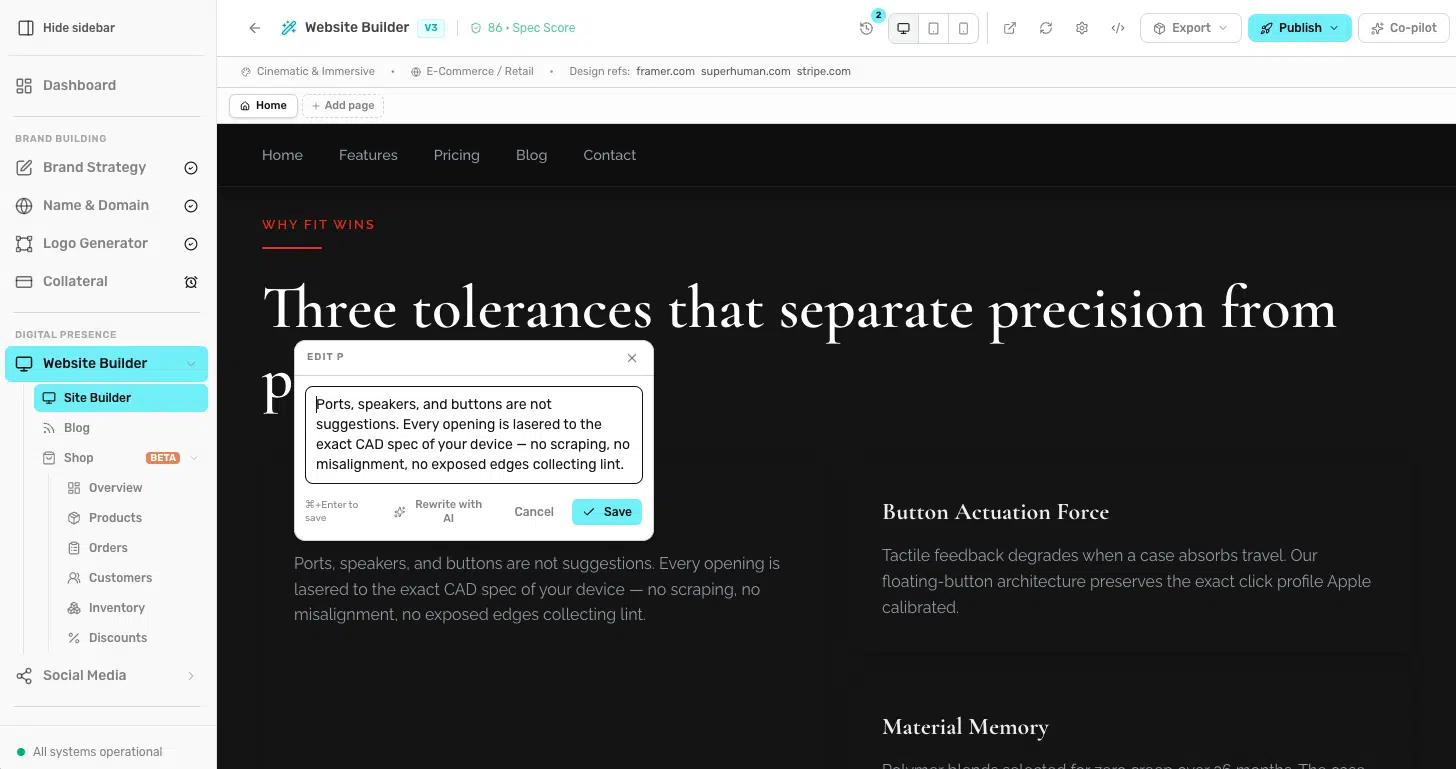
An embeddable website builder lets you drop the editor into your own control panel or customer dashboard. Your user never leaves your product. They click “edit my site” inside your UI, the builder loads in place, they work, they save, they close it. The whole thing feels like a native feature of your platform. This is what most hosting companies actually want.
A multi-tenant website builder means the underlying platform is built to serve many partners at once without any of them seeing each other, each with their own plans, their own users, their own domains, their own data isolation. Every partner runs what feels like a dedicated instance, without you having to operate one.
The two aren’t alternatives. A mature platform gives you both. Multi-tenant on the inside, so it scales cleanly across a partner base. Embeddable on the outside, so it disappears into your product.
That’s the shape of a website builder SDK worth integrating. A clean API, multi-tenant provisioning, an editor you can embed or link out to, and enough hooks that your billing system stays the source of truth.
What the API actually needs to do
If you’re a hosting company running WHMCS, or a SaaS platform running your own control panel, or an agency with an internal ordering system, the API is where the rubber meets the road.
At minimum, a white label website builder API needs to cover:
- Provisioning. Create a tenant, create a site, create a user, all in one call from your order flow.
- Lifecycle. Suspend, unsuspend, terminate. Upgrade and downgrade plans. Attach and detach domains.
- User management. Single sign-on into the editor without making customers log in twice.
- Billing hooks. Webhooks fire when things happen, so your system stays in sync without polling.
- Data access. Export, backup, and migration endpoints that work without a support ticket.
That last point is the one most vendors quietly fail. If your customer’s data lives behind a “contact us to export” wall, you don’t own your channel. You’re renting it.
BrandForge exposes all of the above, which is why WHMCS integration is a few days of work rather than a quarterly project. The specifics on the WHMCS side are covered in the platform integration page, and the underlying editor is documented on the website builder feature page.
The reseller economics question
Here’s the part nobody wants to talk about, and it’s the one that decides whether the partnership actually works.
A website builder SaaS reseller model only holds up if three numbers make sense together:
- Your wholesale cost per site.
- Your retail price per site.
- Your churn.
If the wholesale price is high, you can’t compete on retail. If your retail is competitive but churn is 8% a month, you’re paying customer acquisition costs faster than you’re recouping them. The margin has to survive both.
Good white label platforms understand this and price around it. Volume tiers that actually change the number at 1,000 and 10,000 customers. Domain economics that let you make money on the renewal, not just the first year. Add-ons that fit naturally onto a site subscription. Freedom to package however your market buys.
Bad white label platforms publish one wholesale price and expect you to absorb everything else. That’s a resale agreement pretending to be a partnership.
Why the embeddable vs standalone choice usually goes embeddable
The temptation, especially for smaller hosting companies, is to link out to a hosted builder on a separate URL. Faster to launch. Less integration work up front. Fewer moving parts.
The problem shows up six months in.
Every link-out is a moment where the customer remembers they’re using two products, not one. Every separate login is a small tax on renewal rates. Every branded loading screen from the underlying vendor is a chip off your positioning. It compounds.
An embeddable website builder that lives inside your product, on your domain, with your styling, doesn’t have any of those leaks. The customer builds their site inside your dashboard, publishes to their domain, gets billed on your invoice, and never has a reason to think about who’s powering it underneath.
That’s the version worth building toward. And that’s what a real white label website builder API is for.
The short version
If you’re evaluating platforms:
- Ask whether it’s actually multi-tenant, or whether “white label” means one shared instance with your logo on it.
- Ask what the embeddable path looks like. Editor in an iframe, full SDK, or link-out only.
- Ask what the WHMCS integration or SDK covers. If provisioning, lifecycle, SSO, and webhooks aren’t all there, keep looking.
- Ask what happens to your customer’s data when they leave. If the answer isn’t “they export and go,” the platform isn’t confident in its own product.
- Ask about the wholesale curve at 100, 1,000, and 10,000 customers. If there isn’t one, there isn’t a partnership.
BrandForge was built to answer all of those the way partners want them answered. The full breakdown of the site builder itself covers the product side, and the WHMCS integration covers the plumbing.
If you want to see whether the numbers work for your specific channel, that’s a conversation. Send us the shape of your business and we’ll come back with real economics against it.
Michiel Grotenhuis is CEO and co-founder of BrandForge, the AI-powered white-label brand and site creation platform for hosting providers, registrars, and agencies.