

Why 70% of your customers never upgrade, and what you can do about it without rebuilding your whole business.
Table of Contents
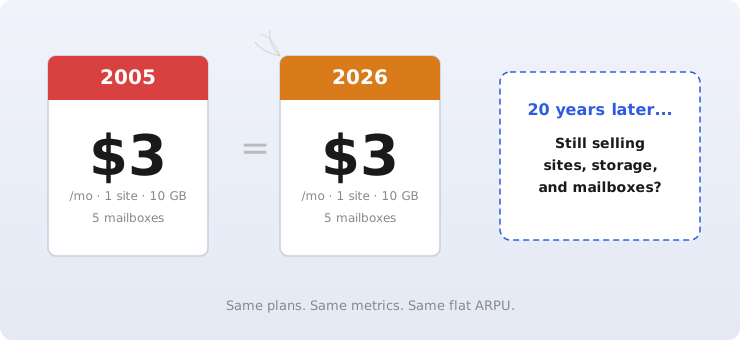
Over the last few years I’ve spoken with a lot of hosting company founders. Major players down to the ones running their operation from the attic. One issue keeps coming back at the smaller end, and it costs real money: pricing pages that could have been printed in 2005 and nobody would notice.
Sites, storage, mailboxes. Climb the ladder. Except nobody climbs it anymore.
I recorded a short video walking through why the model stopped working and what you can do about it without rebuilding your whole business. If you’re running a hosting operation, have a look.
Below is the written version, with everything from the deck expanded.
The 2005 playbook
Open a dozen hosting websites right now. Most of them use the same structure: Basic, Plus, Pro, Ultimate. Each tier adds more websites, more gigabytes of storage, more mailboxes. The assumption is that customers will grow, need more capacity, and climb the ladder.
What changed since then
Four things happened, all at once, and none of them get talked about enough.
WordPress won. Most SMB customers now run one site, maybe three. Nobody is spinning up twenty WordPress installations on shared hosting. The “more websites” upgrade lost its pull.
Email left the building. Google Workspace and Microsoft 365 own business email. Your mailbox quota stopped mattering years ago. Bumping it from 10 to 25 mailboxes is not moving the needle.
Storage became irrelevant. 10 GB was tight in 2005. Today the average WordPress site sits in that comfortably, with images offloaded to CDNs. The storage rung on the ladder is hollow.
Growth stopped meaning capacity. Businesses grow in brand, reach, and revenue. Not in gigabytes on your servers. The unit of customer success shifted, but hosting pricing didn’t follow.
Each of these is obvious in isolation. Put them together and the whole ladder loses its rungs.
The result: a flat line
Pull your own customer distribution right now. If it doesn’t look roughly like this, you’re an exception: 70% on Basic, 18% on Plus, 8% on Pro, 4% on Ultimate.
You acquired them cheap. They stay cheap forever.
Basic was designed as a doorway. It became the destination. Your ARPU chart is a flat line, and your churn is whatever the competitor’s next promo is. The upgrade funnel is not broken because your sales are bad. It’s broken because the plan structure gives them nothing to sell.
The trap you’re in
Here’s what happens when capacity is your only axis.
You compete on entry price. Basic is the shopfront, so Basic keeps getting cheaper. The floor never stops dropping. A race to the bottom where the bottom keeps moving.
You subsidize the wrong customer. Hobby sites soak up support tickets while a handful of professional customers carry the P&L. Your most profitable customers are also the ones with the least reason to stay.
There is no next step to sell. More gigabytes and more sites are not upgrades anymore. They’re line items nobody needs. Your salespeople don’t have a bad pitch. They have nothing to pitch.
The fix: sell capability, not capacity
Same four tiers. Same price points if you want. Completely different sales conversation.
Each tier stops answering “how much stuff do you get?” and starts answering “what kind of customer are you?” Nobody grows into more gigabytes. Everyone can grow into better branding, real e-commerce, and professional tooling.
What this looks like in practice
Pick two product categories you can layer in tomorrow. Security and brand are good starting points because every WordPress customer needs both.
Basic is honestly the hobby plan. Plus, Pro, and Ultimate are for people running a business. Now you have something real to sell.
The reposition
Once your tiers are based on capability, the upsell question becomes simple:
“Are you running this as a hobby, or as a business?”
If it’s a business, Basic is the wrong plan. That’s it. That’s the whole sale.
The persona framing does the selling for you. A hobbyist happily stays on Basic. A business owner self-selects up. You don’t have to convince anyone that they need more disk space. You just have to ask the right question.
Higher entry price. Higher perceived value. A real reason to move up. And your support team stops subsidizing hobby sites with business-grade attention.
The takeaway
The plan is not a storage bucket. It is a professional identity.
Move customers up by giving each tier a reason to exist beyond capacity. Security, brand identity, commerce tools, social media management, website builder. The upgrades write themselves.
You don’t need to rebuild your infrastructure or re-platform. You need to change what each tier contains. That’s a product decision, not an engineering project. Start with two capability layers and see what it does to your upgrade rate in 90 days.
FAQ
Do I need to change my infrastructure to switch to capability-based pricing?
No. Your servers, control panels, and stack can stay exactly as they are. Capability-based pricing is a product and packaging change, not an infrastructure change. You layer new features (security tools, brand builders, e-commerce) on top of what you already run. The tiers change what the customer gets access to, not how you deliver hosting.Won’t my existing Basic customers be upset if I change the plans?What kind of ARPU lift can I actually expect?Where do I find the capability features to add to my tiers?Can I keep the same price points or do I need to raise prices?I’m using WHMCS / Upmind / HostBill. Does BrandForge integrate?
Won’t my existing Basic customers be upset if I change the plans?
You don’t have to touch existing plans. The move is to change what new customers see and what upgrades look like. Grandfather current customers on their current deal, and introduce capability tiers for new signups and as the upgrade path. Most hosting companies run old and new plans side by side during the transition.
What kind of ARPU lift can I actually expect?
It depends on your current mix, but the math is straightforward. If even 15% of your Basic customers self-select into a capability-based Plus plan at double the price, your ARPU shifts meaningfully. The bigger effect is on new customer acquisition: you stop competing purely on the cheapest Basic plan and start attracting customers who value the package.
Where do I find the capability features to add to my tiers?
Security tools (WAF, malware scanning) are available from established vendors you can integrate or resell. For brand, commerce, and marketing capabilities, platforms like BrandForge are built specifically for this: white-label feature bundles you can drop into your existing plans without building anything from scratch. The integration options cover WHMCS, Upmind, and most billing platforms hosting companies already use.
Can I keep the same price points or do I need to raise prices?
You can keep the same price points. The goal is not necessarily to charge more for Basic. It’s to make Plus, Pro, and Ultimate worth choosing. That said, many operators find they can raise the non-Basic tiers because the perceived value is much higher when you’re offering brand tooling and security rather than “10 extra GB.”
I’m using WHMCS / Upmind / HostBill. Does BrandForge integrate?
Yes. BrandForge has WHMCS, Upmind, and HostBill integrations, along with a range of other billing and control panel platforms. Check the full list on the platform integrations page.
