Good brand design has always had a gatekeeper problem. A proper identity, the logo, the color system, the typography, the full kit, used to mean a studio, a few thousand euros, and weeks of back and forth. That math works for a funded startup. It never worked for the plumber, the corner cafe, or the solo consultant who needed a credible look by Friday.
AI is changing that math. It is also generating a lot of noise. Every tool now promises an instant brand at the push of a button, and most of the output looks like it. So the useful question is not whether AI can design a brand. It can produce something. The real questions are what it does well, what it still cannot do, and how that changes the work for people who sell brand and web services for a living.
What AI does genuinely well
Strip away the marketing and there is real substance here. AI is very good at the parts of brand design that are mechanical, repetitive, or just slow by hand.
- Volume and variation. Ask for forty logo directions and you get forty in seconds. Most will be weak. A handful will be worth exploring. That ratio is fine, because the cost of generating them rounds to zero and the value is in finding the one worth refining.
- Clean, usable assets. The gap between a nice-looking mockup and a file a printer can actually use is where a lot of cheap design falls apart. Modern tools can turn a raster concept into crisp editable vectors, resize a mark across a hundred placements, and hold the shape together at every size.
- Systems, not just one-offs. A brand is not a logo. It is a palette, a type pairing, spacing rules, and the logic that keeps them consistent. AI is well suited to generating a coherent system and then applying it across a full kit, from a business card to a social avatar to an email header.
- Consistency at scale. Once the rules exist, machines follow them without drifting. Every asset lands on-palette, on-type, on-spec. For anyone managing many brands at once, that reliability matters more than any single clever idea.
- Access. This is the quiet one. People who were priced out of design entirely can now get a credible starting point. That does not threaten good designers. It serves a market that was never going to hire one anyway.
Where AI still falls short
Here is the part the demos skip. AI generates options. It does not decide. And brand design is mostly deciding.
A strong brand answers questions a model cannot answer for you. Who is this actually for? What do we stand for that the competitor down the road does not? What should someone feel in the first two seconds? Why this blue and not that one? The model has no stake in the business and no read on the room. It produces something plausible and average, because plausible and average is what it was trained on.
That is the trap. The output looks finished, so it is tempting to ship it. But a brand that looks like everyone else’s is not a brand. It is camouflage. Differentiation, taste, meaning, and knowing the specific market are still human work, and they are the work that was always worth paying for. AI makes the first draft cheap. It does not make the judgment free.
The real shift: production drops, direction rises
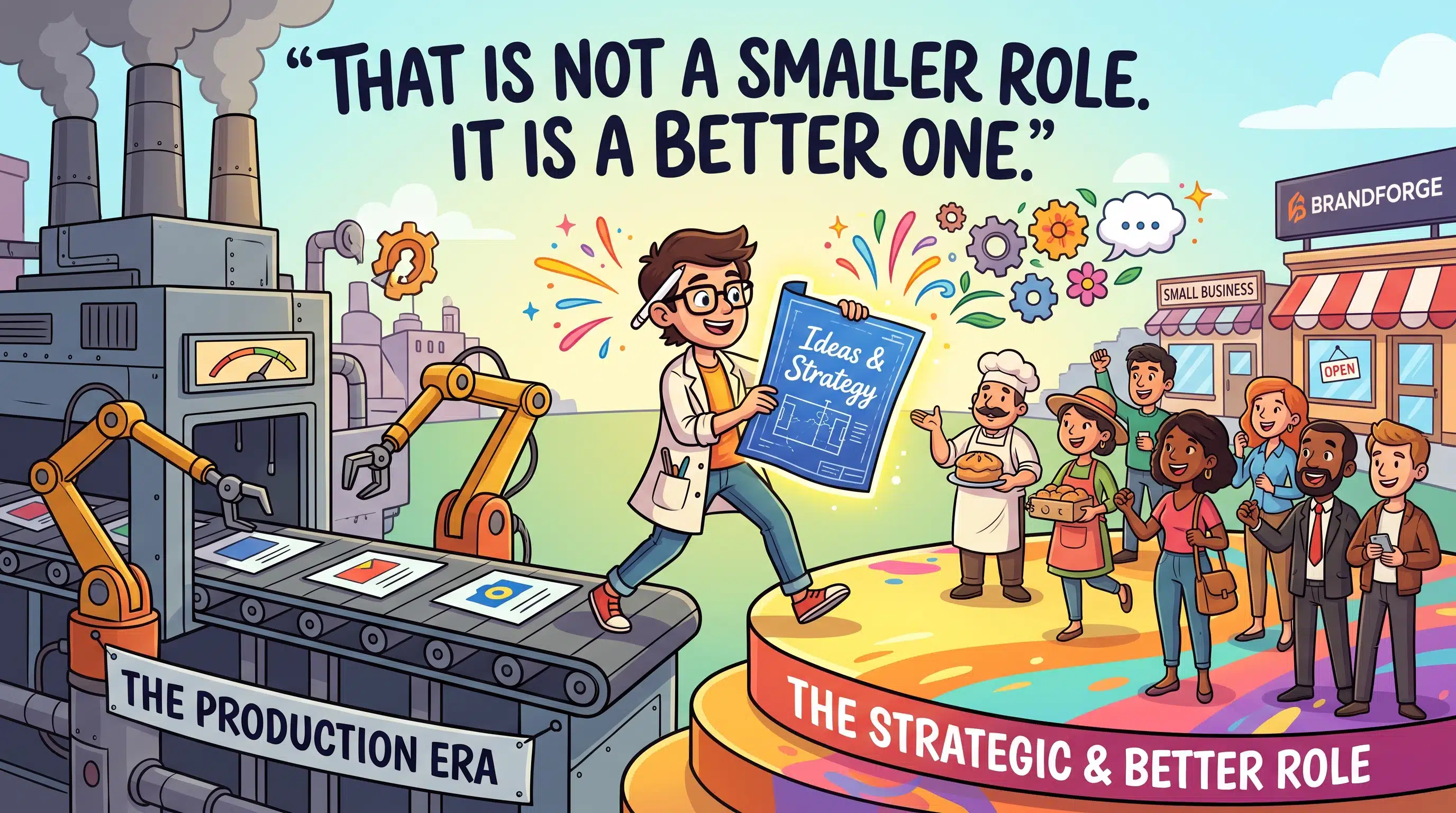
The honest way to describe what is happening is not replacement. It is compression. AI is collapsing the production layer, the hours spent executing a decision once it has been made, close to nothing.
That does not delete the job. It moves it up. The scarce skill stops being can you make the asset and becomes do you know which asset is right. Direction, editing, and taste become the whole value, because production is no longer the bottleneck. The people who win are not the ones who resist the tools. They are the ones who use them to skip the grunt work and spend their time on the calls only a human can make.
It is the same shift photography went through, and typesetting, and web development before it. The tooling got radically cheaper and more people got to participate. The ones who thrived moved up the stack toward judgment. The ones who clung to the manual step got squeezed.
What this means if you sell web and brand services
For agencies, hosting companies, and web professionals, the interesting part is not the technology. It is the economics.
There has always been a floor under custom brand work. Below a certain budget, a project is not worth your time, so you turn it away. That turned-away segment is enormous: the millions of small businesses that need a logo and a basic identity but will never pay studio rates. You could not serve them profitably, so you didn’t.
AI changes the floor. When production costs collapse, work that was never viable becomes a real line of business. You can offer brand creation as a product, at a price that fits an SMB, delivered in minutes instead of weeks, with a margin that actually holds. The same shift that worries a purist is an opening for anyone who sells to volume.
This is the reason platforms like BrandForge exist. The aim is not to replace the designer at the top of the market. It is to let the people who already own the customer relationship, the hosts, the registrars, the agencies, offer AI brand creation under their own name, so they capture a segment they were already leaving on the table. The tool does the production. The partner keeps the brand, the customer, and the margin.
How to adopt AI brand tools without losing the plot
A few rules keep the output above the average the tools drift toward.
- Start with the brief, not the generator. Decide who it is for and what it should say before you ask for a single logo. The tool is faster at execution, not at thinking. Feed it a clear direction or it will give you a clear average.
- Treat the first output as a draft, always. The instant result is a starting point, never the finished product. The value you add is in the edit.
- Pick the direction, then commit. The risk is not too few options. It is too many. Use AI to explore quickly, then narrow hard and refine one path properly.
- Check it against the market, not just your taste. Plausible is easy. Distinct is the job. If the result could belong to any competitor, push it further.
- Own the system, not just the asset. A one-off logo ages fast. A documented system, with colors, type, and usage rules, is what holds a brand together as it grows and what makes it defensible as a product.
The bottom line
AI will not design the next great brand on its own. It does not know what a brand is for. What it does is remove the cost and the wait that kept good-enough design out of reach for most of the market, and it hands the judgment back to people.
That is not a smaller role. It is a better one. The production was never the interesting part. For anyone who sells to businesses that were priced out of design until now, the opportunity is not someday. It is already open.