An architectural breakdown of why e-commerce agencies, SaaS developers, and digital resellers are moving beyond app-bloated e-commerce platforms like Shopify to deploy BrandForge’s 100% white-labeled AI brand strategy, static storefront studio, and merchandise fulfillment engine.
⚡ Executive Summary
Shopify has built a dominant empire in global direct-to-consumer retailing by providing merchants with a hosted checkout engine and app ecosystem. However, for digital marketing agencies, web developers, and software resellers seeking to build high-margin recurring SaaS revenue, Shopify imposes strict operational bottlenecks.
The Agency Problem: Shopify is a retail platform, not a white-label software engine. Your clients interact directly with Shopify branding, face mounting monthly bills for third-party app subscriptions (for basic design, reviews, social scheduling, and print-on-demand), and pay platform transaction fees. Agencies are reduced to basic setup freelancers receiving modest affiliate commissions.
The BrandForge Solution: BrandForge was built specifically for channel distribution. By deploying BrandForge’s white-label e-commerce engine, agencies can offer an integrated brand creation, static storefront publishing, social marketing, and physical merchandise studio completely unbranded under their own agency domain while keeping 80%+ wholesale software margins.
1. The E-Commerce App Bloat Trap: Why Shopify Constrains Agency Resellers
Launching a client storefront on Shopify appears straightforward initially, but agencies quickly run into what the industry calls the “App Stack Tax.” Because Shopify core software focuses primarily on order processing and product catalogs, merchants must install 5 to 15 third-party apps to handle basic marketing, visual design, print-on-demand, and brand management.
For an agency attempting to package e-commerce as a recurring service, this fragmented ecosystem causes severe operational issues:
- Uncontrolled Client Overhead: Monthly SaaS bills for separate apps (such as design tools, social schedulers, print-on-demand connectors, and page builders) routinely push client software costs to $300–$800/month before making a single sale.
- Zero Software Equity for Your Agency: When you send a client to Shopify, you are building brand equity for Shopify. You cannot brand the admin dashboard with your agency logo, set custom wholesale platform rates, or control the underlying user experience.
- Disconnected Pre-Launch Branding: Shopify assumes a business owner already possesses vector logos, brand positioning documents, typography hierarchies, and social media templates. Agencies are forced to conduct design work across external software before setting up the store catalog.
E-commerce agencies and technology providers evaluating a dedicated Shopify alternative are choosing BrandForge because it consolidates upstream brand strategy, vector design, storefront generation, and merchandise fulfillment into one automated SaaS suite that you own and rebrand completely.
2. Architectural Deep Dive: BrandForge Edge Commerce vs. Shopify Monolith
The technical architecture powering e-commerce has evolved dramatically. Modern online stores require instant mobile responsiveness, zero server latency, and seamless multi-channel product distribution.
Shopify relies on a monolithic infrastructure powered by its proprietary Liquid templating language. When a customer lands on a Shopify storefront, dynamic server queries render the page, compile third-party app scripts, and execute dynamic database lookups. As merchants add more tracking pixels and app scripts, site speed degrades, directly harming ad conversion rates and mobile search rankings.
BrandForge transforms storefront delivery through a decoupled Static Edge Commerce compiler. The system pre-renders catalog structures, product pages, and visual assets into optimized, lightweight HTML/CSS bundles served directly from global edge servers. Dynamic shopping cart and checkout interactions execute via lightweight API calls. This static compilation guarantees near-instant page load speeds, perfect Lighthouse performance scores, and enhanced security with no database server footprint for attackers to target.
| Platform Capability | Shopify | BrandForge Platform |
|---|---|---|
| Distribution & Business Model | Closed B2C Retail Platform | 100% White-Label B2B Reseller Engine |
| System Architecture | Monolithic Server Rendered (Liquid) | Decoupled Static Edge CDN Commerce |
| AI Brand Strategy DNA | ❌ None (Requires external agency work) | ✅ Automated Archetype, Audience & Voice |
| Vector Logo Suite (SVG Exports) | ❌ Basic Hatchful app (Raster PNGs) | ✅ Production-Ready AI Vector Suite |
| Social Media Promotion Engine | ⚠️ External Paid App Store Subscriptions | ✅ Native Brand-Aligned AI Scheduler |
| Web2Print & On-Demand Merch | ⚠️ Third-party app connectors (Printful/ify) | ✅ Built-In Native API Print Logistics |
| Agency Revenue Model | Affiliate Revenue Share (20%) | ✅ Wholesale SaaS Markup (Keep 80%+) |
3. Five Core Reasons Resellers Choose BrandForge Over Shopify
Pillar 1: Complete Brand DNA & Vector Generation Before Store Launch
In Shopify, creating a store starts with selecting a generic theme. The platform provides no assistance in writing product positioning copy, establishing brand voice guidelines, or generating visual identity kits.
BrandForge solves the brand creation equation upstream. When onboarding a new client, our platform uses our AI Brand DNA Engine to build positioning profiles, core values, target audience avatars, and tone-of-voice rules. These rules feed directly into our AI Vector Logo Generator to export full vector brand packages (SVG, EPS, PNG, PDF style guides) that style the storefront automatically.
Pillar 2: Native Static Storefront Builder Without App Subscriptions
Instead of requiring merchants to install half a dozen apps for landing pages, image optimization, and banner creation, BrandForge embeds these capabilities natively into our static publishing engine. You can inspect software integration possibilities on our SaaS Partner Portal to see how software companies embed our store builder directly into their core web applications.
Pillar 3: Native Web2Print & On-Demand Merchandise Fulfillment
Selling physical branded goods (t-shirts, hats, coffee mugs, packaging boxes, and business stationery) on Shopify requires third-party print-on-demand apps that charge retail fulfillment prices, squeezing merchant margins.
BrandForge integrates physical merchandise manufacturing into the core platform through our Web2Print Fulfillment Engine. When a client approves their logo inside your white-labeled portal, BrandForge automatically renders the vector graphics onto print-ready product mockups. Clients can order physical merchandise directly from their account dashboard. Orders route automatically to global production facilities, creating an automated physical revenue stream for your agency on every print order.
Pillar 4: Automated Social Media Co-Pilot for E-Commerce Promotion
Driving traffic to a new online store is the biggest challenge e-commerce clients face. On Shopify, post-launch social promotion requires setting up external scheduling tools like Buffer or Hootsuite and writing post copy manually.
BrandForge includes a built-in Social Media Co-Pilot that connects directly to the storefront catalog and Brand DNA profile. The Co-Pilot automatically drafts product showcase posts, designs visual social banners matching store branding, and schedules campaigns across Instagram, Facebook, LinkedIn, and X without requiring external app subscriptions.
Pillar 5: 100% White-Label Portal & REST API Embeds
When you build a client store on Shopify, the client manages their billing with Shopify, contacts Shopify support, and accesses a Shopify-branded dashboard. You remain a service provider rather than a essential software partner.
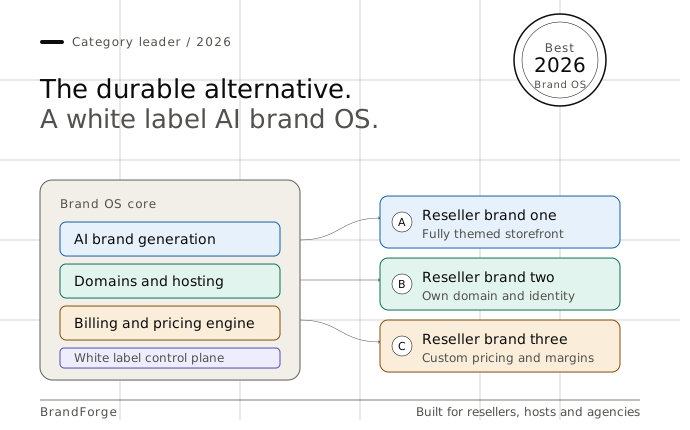
BrandForge allows you to brand the entire administrative interface. Host the client portal on your custom domain, set your own subscription pricing, and manage client access centrally. You can also integrate store creation features directly into custom software dashboards via REST API webhooks.
4. Financial Unit Economics: Affiliate Revenue Share vs. Wholesale SaaS Ownership
The financial disparity between reselling Shopify as a Partner and white-labeling BrandForge as a software reseller is significant. The comparison below illustrates unit economics for an agency managing 30 active client store accounts:
Financial Comparison: Monthly Agency Revenue Across 30 Active Stores
Shopify Partner Model
- Average Store Subscription: $39/mo client cost
- Shopify Partner Commission (20%): +$7.80/mo per client
- Third-Party App Costs to Client: -$250/mo external
- Agency Retainer (Volatile): ~$500/mo management
- Agency Software MRR: ~$234/mo total
BrandForge White-Label SaaS Model
- Branded E-Commerce Platform Billing: $297/mo client cost
- Wholesale BrandForge Workspace Fee: -$45/mo fixed
- Static Edge Hosting & CDN: $0 extra
- Web2Print Physical Merch Orders (25% Markup): +$85/mo per store
- Agency Software MRR: ~$10,110/mo total
By reviewing our comprehensive guide to White-Label Reseller Models, agency owners can analyze how wholesale pricing tiers enable high monthly recurring software revenue while reducing total software costs for clients.
5. Implementation Guide: Launching White-Label E-Commerce with BrandForge
Transitioning your agency to offer automated AI brand creation and static e-commerce hosting is simple. Follow this four-step deployment process:
Step 1: Custom Portal Configuration
Connect your agency domain (e.g., commerce.youragency.com), upload your logo, define custom dashboard color schemes, and setup client welcome emails. Your agency branding is applied across all customer touchpoints.
Step 2: API & Billing Integration
Connect your payment processor (Stripe/PayPal) or billing engine. Use our API webhooks to automatically trigger workspace setup whenever a new client subscribes on your website.
Step 3: Execute AI Store Generation
Input a prompt describing the client’s business niche and product lineup. BrandForge’s engine builds their Brand DNA, vector logos, static storefront layouts, product copy, and initial social media campaign assets in minutes.
Step 4: Enable Merch Store & Set Retail Markups
Enable the Web2Print merchandise tab inside the client workspace, set your desired retail profit percentage on physical goods, and grant client access to their new branded e-commerce portal.
Ready to Resell Complete AI Brand & E-Commerce Studios?
Stop losing margins to app ecosystems and retail e-commerce engines. Join top digital agencies, SaaS providers, and resellers expanding their MRR with BrandForge.
Discover how our agency platform operates by visiting BrandForge for Agencies, checking our wholesale Partner Pricing Tiers, or booking a tailored demonstration with our team on our Live Demo Booking Page.
Frequently Asked Questions
Why are agencies searching for a white-label Shopify alternative in 2026?
While Shopify serves direct consumers well, it presents clear drawbacks for B2B resellers. High third-party app costs, co-branded administrative interfaces, and lack of upstream brand creation tools push agencies toward BrandForge for complete custom-domain white-labeling, REST API integration, and wholesale margin control.
How does BrandForge handle e-commerce differently than Shopify?
Shopify uses dynamic server rendering (Liquid) requiring dynamic database lookups and external apps for design and marketing. BrandForge combines AI Brand DNA strategy, vector logo creation, static edge-hosted storefronts, social co-pilot scheduling, and print merchandise fulfillment into one automated platform.
Can software platforms and SaaS providers integrate BrandForge commerce via API?
Yes! BrandForge provides REST APIs and webhooks engineered specifically for software partners, web hosts, and registrars. Learn more about API integration capabilities on our SaaS Partner Portal.