Almost every white-label deal we sign starts with the same conversation. Which reseller billing model should the partner use with their end customers, and how should the wholesale price flow into it. The question sounds simple. It is not. Choosing the wrong reseller billing model is the single fastest way to kill a promising white-label product.
We have watched partners run every possible combination. Flat-rate, per-site, per-user, usage-based, tiered, revenue-share, freemium-with-upsell. The pattern that emerges is that three reseller billing models account for almost every successful deployment, and each of them wins in a specific context. This piece is about which model fits which context, with the actual pricing math behind each one.
Table of Contents
Why the reseller billing model choice matters more than the product
A great product with the wrong reseller billing model ships as a failure. A mediocre product with the right reseller billing model can quietly generate seven figures of ARR. The billing model determines the reseller’s incentive structure, and the reseller’s incentive structure determines whether the product ever gets sold to anyone.
Three ways the reseller billing model breaks a deployment. First, the wholesale price is set at direct-to-consumer economics rather than reseller economics, so the reseller has no margin to sell against Wix. Second, the metric that triggers billing does not match how the reseller thinks about their customer base, so ops and finance disagree every month. Third, the pricing structure is optimized for the vendor’s revenue predictability at the expense of the reseller’s ability to run promotions, bundle, or attack a specific segment. Any one of those failures is enough. Two of them are fatal.
What a reseller billing model actually has to do
Before the three patterns, one definition. A reseller billing model is the pricing structure that flows from the vendor to the reseller, distinct from the pricing structure the reseller uses with their end customers. Those are two separate decisions, and confusing them is the most common early mistake.
The vendor-to-reseller pricing is a wholesale question. It has to allow the reseller enough margin, handle the reseller’s cash flow patterns, and give predictability without locking either party into a bad long-term deal. The reseller-to-end-customer pricing is a retail question. It has to compete against Wix, Squarespace, and whatever else is in the market, and it has to make sense to a small business buyer who is not thinking about wholesale rates.
The right reseller billing model creates enough gap between wholesale and retail that both sides make money. The wrong one either squeezes the reseller into loss-making sales or forces retail prices high enough that no one buys.

The 3 proven reseller billing model patterns
Below are the three that consistently produce sustainable partner economics. Each one has trade-offs. None of them is universally correct.
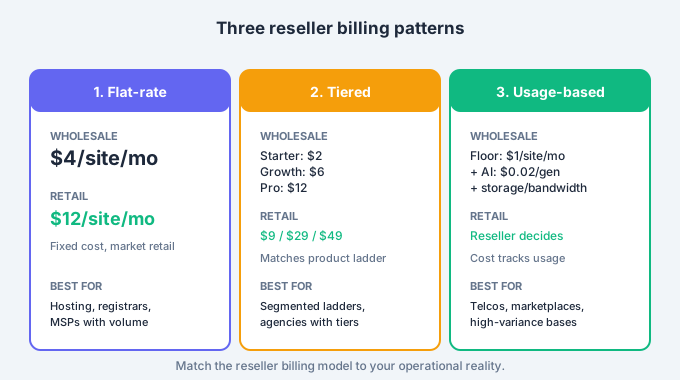
1. Flat-rate attach
The simplest reseller billing model. A flat monthly wholesale price per active site, regardless of end-customer plan or usage. Typically in the $2 to $6 range for a serious white-label website builder.
The reseller uses that wholesale rate as their cost basis and prices retail wherever their market allows. Common patterns are $9 to $15 per month retail on the low end and $25 to $49 on higher tiers with add-on services. The math is straightforward. Wholesale is a fixed input cost, retail is a market-set output price, margin is the difference.
Flat-rate attach wins for resellers with a strong existing customer base and a preference for operational simplicity. Hosting providers with tens of thousands of shared hosting customers usually land here. The reseller billing model is easy to reason about, easy to invoice, easy to reconcile, and easy to expand. The main downside is that heavy-usage end customers cost the vendor more to serve than light-usage ones, so vendors often cap flat-rate deals at a minimum volume threshold to make the average economics work.
2. Tiered by end-customer feature set
The vendor prices differently based on which tier the reseller resells to the end customer. A “starter” tier might be $2 wholesale, a “growth” tier $6, a “pro” tier $12. The reseller uses whichever tier maps to what they sold their customer.
This reseller billing model matches the way most resellers naturally think about their product ladder. If the reseller sells a $9 site plan, they buy the starter tier from the vendor. If they sell a $29 site with e-commerce, they buy the growth or pro tier. The wholesale-to-retail spread stays roughly constant across tiers, which keeps margin percentages predictable even as ARPU changes.
Tiered by feature set wins for resellers who segment their end customers or run a ladder of products. Registrars with a “domain plus starter site” bundle and a “domain plus e-commerce site” bundle land here often. Agencies with clearly delineated service tiers do too. The reseller billing model gets a little more complex to reconcile because the vendor needs to know which tier each end customer is on, but modern billing platforms handle that mapping cleanly.
3. Usage-based with a floor
The vendor charges based on a real usage metric, most commonly generated AI requests or storage or bandwidth, with a floor amount to cover baseline platform costs. The reseller absorbs the usage risk, meaning if end customers use a lot, the reseller pays more; if they use little, the floor still generates predictable vendor revenue.
Usage-based with a floor is the newest of the three patterns and the most technically sophisticated. It works best when the underlying costs actually track a specific metric, which for AI-heavy products they do. Generation costs scale with model calls. Storage costs scale with content volume. Bandwidth scales with page views. When those costs are the majority of the vendor’s cost basis, aligning wholesale price with usage is fair to both sides.
This reseller billing model wins for large partners with big variance across their end-customer base. A telco with millions of low-usage customers benefits from a low per-usage rate. A design agency with a few dozen power-user customers benefits from paying only for what they consume. Both sides get more accurate cost signals than a flat-rate model can provide, but the reconciliation overhead is real and the model is harder to explain to sales teams.

When each reseller billing model wins
Rather than trying to rank the three, here is the matrix of when each one fits. Match the reseller’s context to the model that removes the most friction.
- Small to mid-size hosting providers, registrars, MSPs. Flat-rate attach almost always wins. The operational simplicity is worth more than the marginal optimization other models offer.
- Large registrars or hosting providers with a segmented product ladder. Tiered by feature set. The reseller is already segmenting internally, so the reseller billing model should mirror the segmentation.
- Telcos, cloud marketplaces, very large aggregators. Usage-based with a floor. Volume is high enough that usage variance becomes the dominant factor.
- Agencies and boutique resellers with few but high-value end customers. Flat-rate or tiered. Usage-based is overkill and the reconciliation cost outweighs the fairness benefit at low customer counts.
- New partners with unknown demand. Flat-rate for the first year, then reassess. A simple reseller billing model up front lets both sides learn how the market actually behaves before optimizing.
The pattern is that operational complexity should match business complexity. Simple reseller, simple model. Complex reseller, more precise model.
Common mistakes to avoid
Three failure modes we see partners walk into repeatedly.
- Copying the vendor’s direct-to-consumer pricing as a wholesale sheet. Vendors that started direct-to-consumer sometimes present their consumer price list to a reseller with a modest volume discount. That is not a reseller billing model. That is a coupon. Real reseller pricing starts from wholesale economics, not retail economics.
- Locking the reseller into a minimum that exceeds their realistic year-one demand. Vendors love MRR minimums. Resellers hate them. If the minimum is set higher than what the reseller can plausibly hit in twelve months, the deal is a loss-maker for the reseller from day one and the relationship sours before it starts.
- Charging per seat when the reseller sells per customer. Per-seat pricing makes sense for tools where multiple users at a customer share the product. It does not make sense for a website builder where each end customer is one seat by definition. Per-seat pricing in that context is a reseller billing model that adds friction without adding fairness.
The through-line is that the reseller billing model has to match how the reseller actually operates, not how the vendor prefers to bill.
How to model the wholesale price
For any of the three patterns, the wholesale price has to leave enough room for the reseller to hit their target margin. A rough model that works across most contexts:
- Take the retail price the reseller will realistically charge.
- Subtract the reseller’s assumed CAC per customer, amortized over expected LTV.
- Subtract the reseller’s support cost per customer per month.
- Subtract the reseller’s target contribution margin, typically 40 to 60 percent.
- Whatever remains is the maximum wholesale price the reseller can pay while making the deal work.
If the vendor’s wholesale price is higher than that number, the reseller either has to raise retail (usually not possible in a competitive market) or accept a lower margin (usually not sustainable). If the vendor’s wholesale price is lower, both sides have room to invest in marketing, promotions, or product improvements.
For a deeper walk-through of the numbers for a hosting reseller specifically, our WHMCS integration overview and reseller economics page cover the concrete calculations we recommend to partners. For the strategic framing, our post on the AI brand builder as a new category explains why the reseller billing model matters more in this category than in older SaaS categories.
Externally, the SaaS pricing benchmarks published by OpenView Partners are the most useful third-party reference we have found for calibrating wholesale-to-retail spreads across categories.
Where to go next
The reseller billing model is not the exciting part of the product. It is the boring, foundational part that determines whether the exciting parts ever reach a customer. Get it right and the rest of the go-to-market works. Get it wrong and no product feature can save the deal.
We designed BrandForge from the start to support all three reseller billing model patterns above, because we knew we would sell into hosting, registrar, telco, and agency segments simultaneously and no single pricing structure would work for all of them.
- If you are evaluating BrandForge as a partner, the partner program overview is the right starting point.
- For a walkthrough of the reseller billing model options we support, book time via the demo request page.
- If you want the shorter product-level view, our features overview covers what the platform actually does.
Pick the reseller billing model that matches your operational reality. Pricing complexity should serve the business, not the other way around.