

Every quarter, someone at a hosting company gets pitched two dozen new SaaS tools. Each one promises new revenue. Each one wants to be its own thing: separate login, separate billing, separate migration, separate roadmap. Very few of them survive the pitch meeting.
We built BrandForge for the ones that get past that meeting. Not by having the loudest demo, but by understanding what it actually takes to get adopted inside a hosting business. Which is: meet you where you already work.
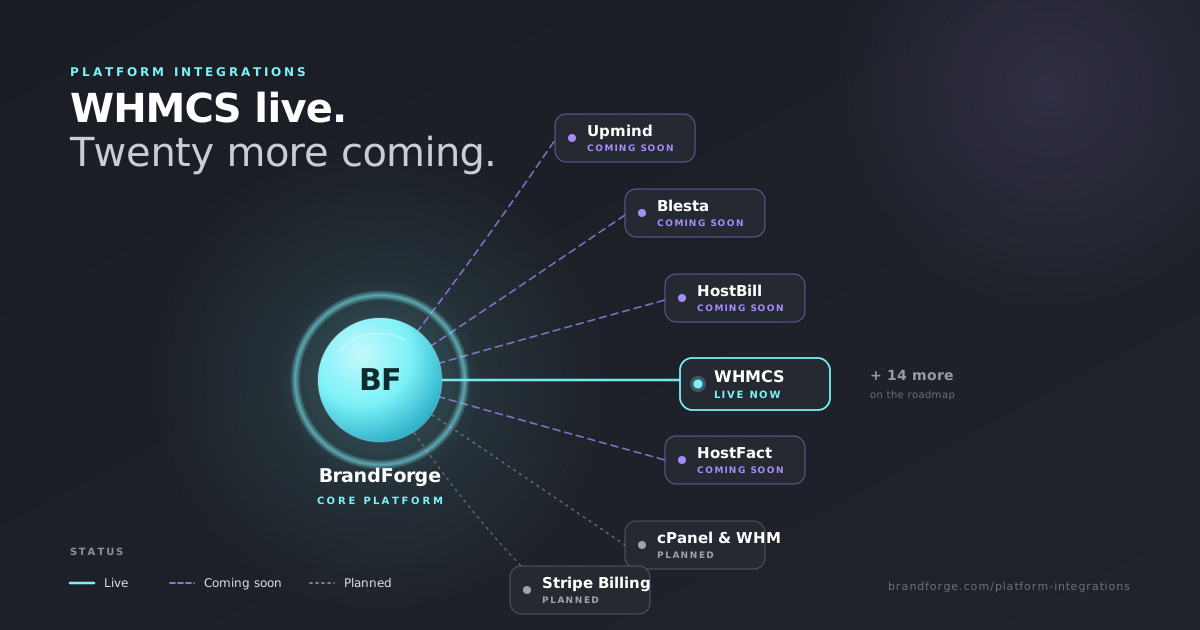
Today the first piece of that is live. The BrandForge module for WHMCS is available in the partner portal. Twenty more platform integrations are on the way, from Upmind and Blesta through to Plesk and cPanel. Here is where we are, where we are going, and why we built it this way in the first place.
What is live today
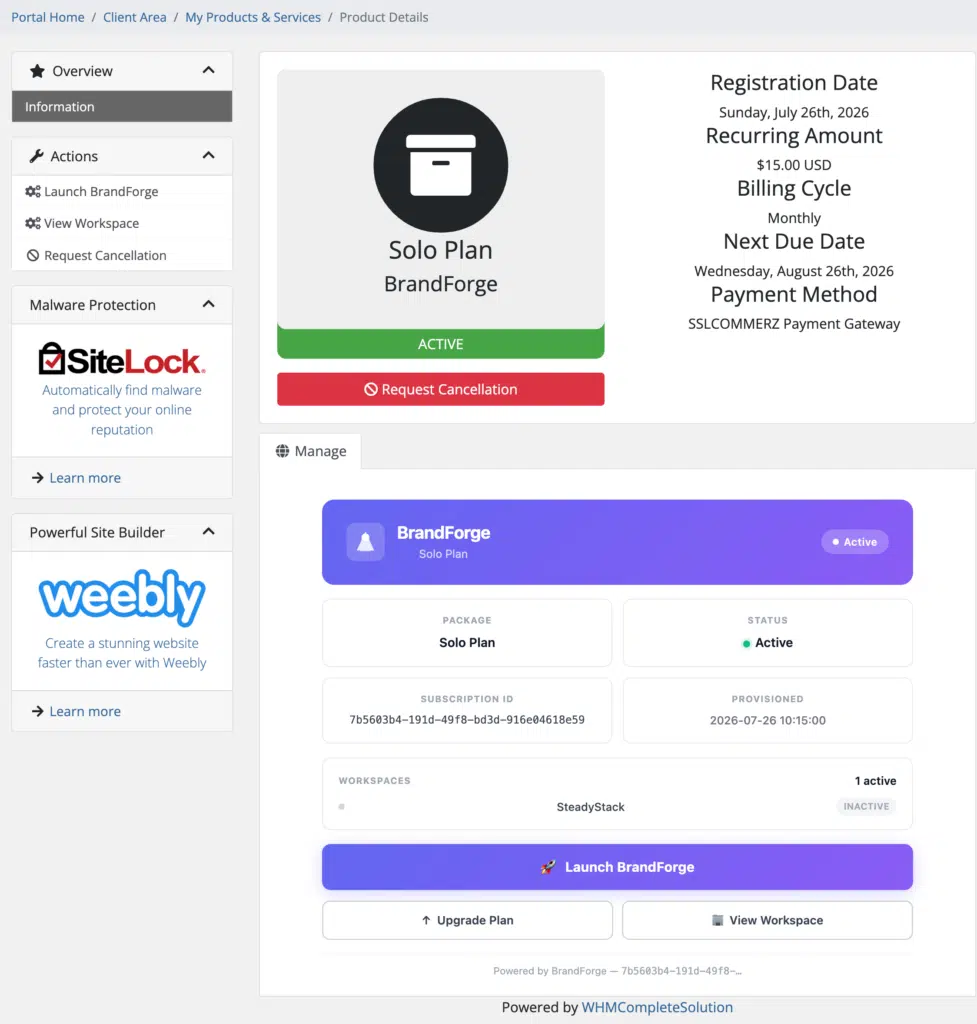
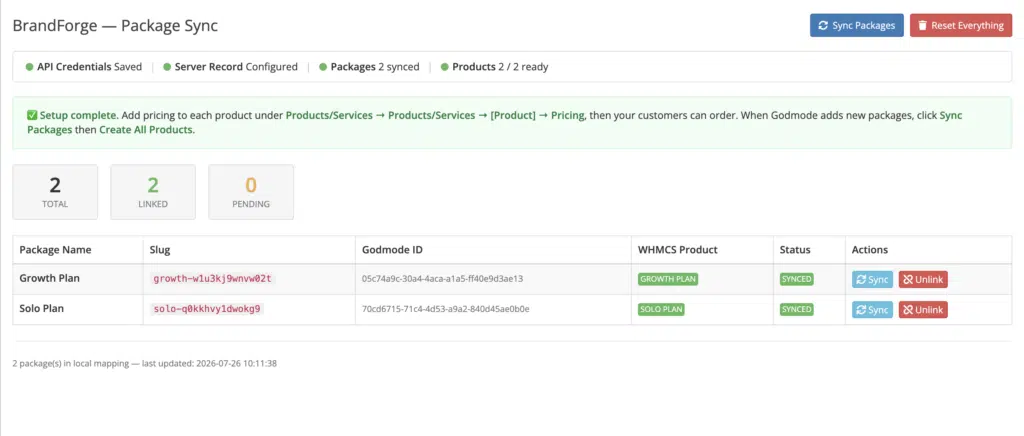
The WHMCS module is a native provisioning module. It ships in the partner portal, installs into /modules/servers/brandforge/, and handles the full lifecycle: create, suspend, unsuspend, terminate, upgrade, downgrade. Customer subscriptions in WHMCS become BrandForge accounts. Cancellations in WHMCS propagate. Plan changes propagate.
For anyone selling into the WHMCS installed base, that means BrandForge shows up in your cart alongside domains, hosting, and email, with your logo and colours, your domain, your SSL. Retail is yours. Wholesale is ours. You keep about half.
You can read the details on the WHMCS integration page, or see the full lineup on the platform integrations hub. You can find the WHMCS Module download link here.
What is next
The waitlist is open for four billing platform integrations we are building next:
- Upmind — native provisioning provider, built on the open-source SDK
- Blesta — PSR-compliant service module
- HostBill — multi-brand ready, for EU enterprise resellers
- HostFact — for Dutch and Belgian hosters, in Dutch, with a Nederlandse module UI
I am not going to give you dates yet, because dates in software either turn into promises we regret or lawyer-friendly non-commitments that mean nothing. What I will tell you is that these are the four we are actively building against. If you are on that waitlist, you get the module the moment it lands, and you get to shape what it looks like before it ships.
What is on the roadmap after that
Beyond those five, the current planned list is:
Billing platforms: FOSSBilling, Clientexec, WiseCP, Ubersmith, CloudBlue Commerce, CloudBlue Connect.
SaaS billing: Stripe Billing, Chargebee, Recurly.
Control panels: cPanel and WHM, Plesk, DirectAdmin, CloudPanel, HestiaCP, CyberPanel, ISPConfig.
That is 21 integrations in total. One is live. Four are next. Sixteen are further out. Every one has a page with its own honest status, its own technical spec sheet, and a mailing list you can join if you care about it. If the number on that list moves, your platform gets prioritised higher. That is the whole model.
Why we built it this way
The uncomfortable truth about most AI SaaS tools that get pitched to hosting companies is that they were built assuming direct-to-consumer distribution first and channel distribution as an afterthought. They have a website with a “Buy now” button, a self-serve signup, a Stripe checkout. Then they discover the hosting channel exists and try to figure out how to bolt a reseller programme on top of that.
The result is what lands on your desk: a tool that wants you to redirect your customers to their platform. Their branding. Their support. Their billing. You get a referral fee, and your customer stops being your customer.
BrandForge was built the other way around. Channel-first. There is no direct-to-consumer BrandForge homepage where a small business owner buys a plan for EUR 19 a month. The way BrandForge gets to that small business owner is through you: through the hosting brand they already trust with their domain and their site. That means BrandForge has to live inside your stack, not adjacent to it.
That is what these integrations are. Not “add BrandForge as an external service.” Native modules in your billing platform. Native tiles in your control panel. Provisioning that fires when you provision a hosting account. Cancellations that propagate when your customer cancels. Your logo, your domain, your SSL, from the cart through to the customer’s brand kit PDF.
And if the integration you need is not there yet
We are 20 short of finishing this list. If you run WiseCP, or ISPConfig, or something we have not listed at all, you have two options.
Option one: get on the waitlist for the integration closest to your stack. That moves it up. We prioritise based on real partner demand, not internal guesses. If a competitor of yours is already on that waitlist, being on it too still counts. Volume matters.
Option two: build against the REST API today. Every BrandForge feature is API-accessible. Provisioning, white-label config, brand kits, subscriptions, webhooks. If you want to build a bespoke provider for a homegrown billing system, or wire BrandForge into an ERP we have never heard of, you can. The docs are open. The API is the same one our own modules use, so nothing about the custom route is second-class.
What we want from you
Tell us which platform matters most. Not through a survey. Through the waitlist button on that platform’s page. If nobody signs up, it moves down the list. If your platform’s page fills up, it moves up. That is the whole prioritisation model, and it is honest by design.
Browse the full list of integrations and click through to whichever ones matter to you. If your platform is not on the list at all, email me at [email protected]. If I can build it into the roadmap, I will.
The hosting channel does not need another SaaS tool bolted onto the side. It needs tools that arrive as modules for the systems you already run. That is what we are shipping, one integration at a time. WHMCS is the first. It will not be the last.
Michiel Grotenhuis
CEO, BrandForge
